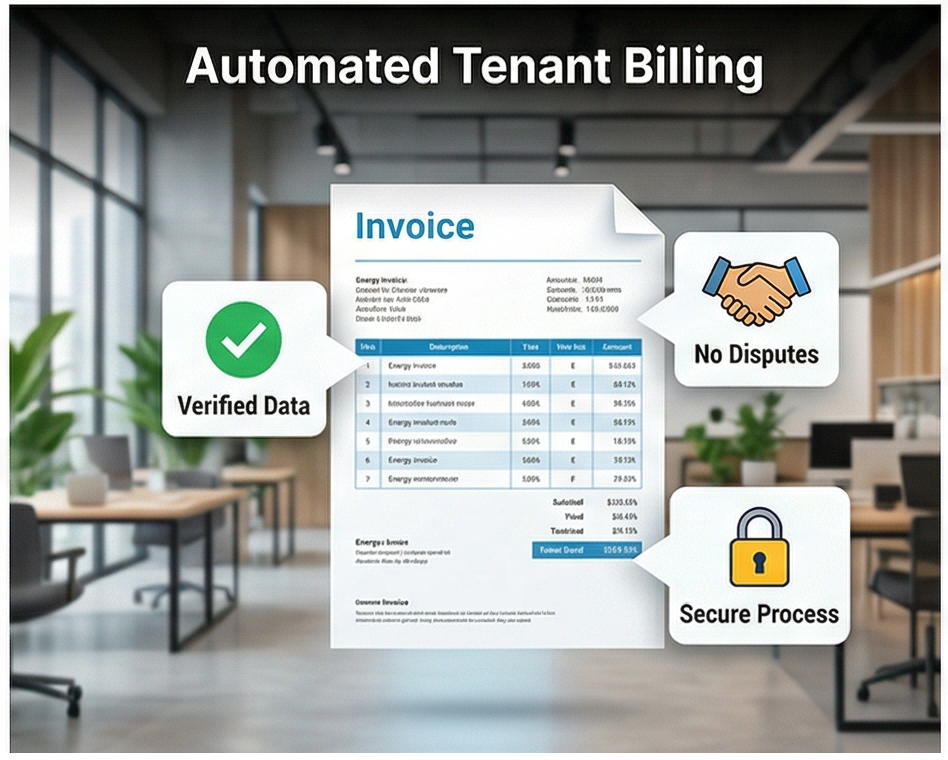
The Dispute Problem
If you manage a multi-tenant building — whether it's an IT park, commercial complex, mall or mixed-use development — you've dealt with billing disputes. The tenant on the 5th floor says their bill is too high. The anchor tenant on the ground floor questions the common area allocation. The co-working space wants hourly billing, not monthly.
The root cause is almost always the same: manual processes. Manual meter reading introduces human error. Spreadsheet calculations miss edge cases. Monthly readings hide consumption spikes. And when a tenant challenges a bill, you have no timestamped, tamper-proof data to show them.
What Automated Tenant Billing Actually Does
An automated tenant billing system connected to your BMS replaces every manual step in the chain:
1. Real-Time Sub-Metering
Every tenant meter (electricity, chilled water, DG backup, water) is read automatically — every 15 minutes, not once a month. This means you have 2,880 readings per meter per month instead of 1. Anomalies are detected in real-time, not discovered during billing.
2. Automated Common Area Allocation
Common area energy (lobby, lifts, parking, fire systems) is the biggest source of disputes. A proper billing system calculates each tenant's common area share using defined rules — proportional to leased area, actual occupancy hours, or a hybrid model. The formula is transparent and auditable.
3. Multi-Tariff Support
Different tenants may have different tariff structures — peak/off-peak, time-of-day, demand-based, or flat rate. The billing system applies the correct tariff to each tenant's consumption automatically. Slab-based pricing, DG surcharges and power factor penalties are calculated without manual intervention.
4. Automated Invoice Generation
At the end of each billing cycle, invoices are generated automatically with consumption breakdowns, tariff calculations, common area charges and historical comparisons. Tenants can access their consumption data in real-time through a web portal — they can verify their own bill before it's even issued.
5. GHG and Sustainability Reporting
With ESG reporting becoming mandatory for large corporations, tenants increasingly need carbon footprint data for their leased spaces. Automated billing systems can generate per-tenant GHG reports using IPCC emission factors, providing scope 2 emissions data that tenants can use directly in their sustainability disclosures.
The Revenue Impact
Revenue leakage in manually billed buildings is typically 3–8% of total energy cost — consumption that happens but isn't billed because of meter reading gaps, calculation errors or tenants underpaying without challenge.
For a building billing Rs 2 crore per year in energy charges, that's Rs 6–16 lakh in lost revenue annually. Automated billing recovers this immediately.
Implementation Without Disruption
The most common objection to automated billing is: "We already have meters — we'd need to replace everything." Not true. Modern billing platforms integrate with existing Modbus energy meters through protocol gateways. Your existing meters stay. The gateway reads them automatically and sends data to the billing platform.
No rewiring. No meter replacement. No downtime. Typical deployment: 2–4 weeks for a 50-tenant building.
The goal isn't just accurate billing — it's making disputes mathematically impossible. When every reading is timestamped, every calculation is transparent and every tenant can verify their own data, there's nothing left to argue about.