Why 'BTL Listed' Is Not the Same as Truly Native BACnet
Copied to clipboard ✓
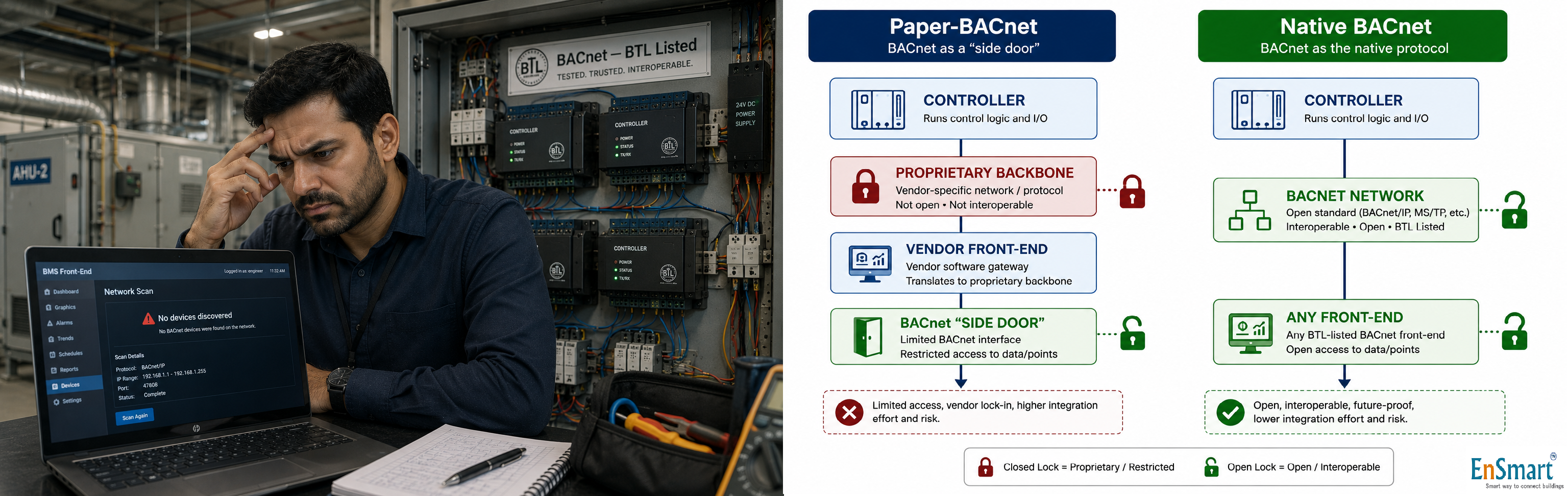
A Chennai IT-Park Retrofit, a Front-End That Refuses to Discover
Murugan is the commissioning engineer on a fourteen-floor IT park retrofit in Chennai. The owner has bought a new BMS front-end. The existing controllers across all fourteen floors are stamped with the words: "BACnet — BTL Listed." In theory, the new front-end should discover all of them in minutes. In practice, Murugan's screen shows zero devices. Then one. Then six. Then zero again. He restarts the front-end. He verifies the IP addresses. He verifies the BACnet network number. He runs a packet capture. The packets are there. The controllers are responding to some requests, but not to others. He calls the controller vendor's support line. The voice on the other end is patient and final: "Sir, our controllers are designed to work best with our own front-end. Have you considered upgrading to our latest workstation? It will solve all your discovery issues." Murugan replaces the receiver. He has heard this answer before. Every retrofit has the same conversation. The controllers print "BACnet" on the datasheet. They pass the BTL listing test. Their PICS document is on file. And yet, when a third-party front-end tries to read them deeply, things fall apart. Every single one of these problems has one cause — and one solution.The Two Architectures You Will Find in the Field
Behind the same word "BACnet", two very different architectures exist: ``` Paper-BACnet (the common case) ───────────────────────────────────────── Field controllers talk to the vendor's front-end through a proprietary backbone — full functionality. A BACnet "side door" is added on top — limited services, limited objects, limited COV support. Third-party front-ends knock on the side door. Discovery works partially. Read works partially. Write rarely works. COV often does not work. The label "BACnet" is true. The promise of openness is not. ``` ``` Truly Native BACnet ───────────────────────────────────────── Field controllers expose every variable as a discoverable BACnet object — no proprietary backbone underneath. Any compliant front-end discovers, reads, writes, subscribes, without any translation layer. The "BACnet" label is not a side door — it is the front door. There is no other door. A different integrator can take over. A different front-end can replace the existing one. The building stays open. ```Three Field Tests That Separate the Two
The datasheet word "BACnet" is not enough. Three field tests are: ``` Test 1 — Object Discovery A third-party BACnet client is pointed at the controller. Pass: every variable shows up as a discoverable BACnet object. Fail: only a sample shows up; key sequences are invisible. Test 2 — COV Subscription The third-party client subscribes to a value. The value changes at the controller. Pass: the client receives the change-of-value within seconds. Fail: the client receives nothing, or has to poll forever. Test 3 — Peer-to-Peer Object Exchange Two BACnet controllers from different vendors are placed on the same network. Each is asked to read the other's objects. Pass: communication works directly, without going through a server. Fail: communication only works through the vendor's own front-end. ``` A controller that passes all three tests is truly native. A controller that fails any one of them is paper-BACnet — open in name only.What This Means for a Specification
When a consultant writes a BMS specification today, "BTL Listed" is the minimum bar. It is necessary, but not sufficient. The real bar — the one that protects the building for the next twenty years — is: ```- Every variable shall be exposed as a discoverable BACnet object.
- The PICS document shall be public (not under NDA).
- COV subscription shall be supported on all dynamic objects.
- Peer-to-peer object exchange shall be supported between controllers.
- A third-party front-end shall be demonstrated against the controller
Related Topics
- What is BMS integration? — how a BMS connects with VFDs, energy meters, BACnet/Modbus devices and other building systems
- How to design a BMS system step by step — the complete BMS design methodology covering site survey, IO list, controller selection, sequence of operations
- What is a Building Management System (BMS)? — fundamentals of BMS controls and architecture for HVAC, lighting, energy and access
- What is BMS commissioning? — the disciplined commissioning process that turns a BMS install into a working building brain
- Browse all DDC Controllers topics — more from this section of the EnSmart BMS Library
Related Topics
- What is BMS integration? — how a BMS connects with VFDs, energy meters, BACnet/Modbus devices and other building systems
- How to design a BMS system step by step — the complete BMS design methodology covering site survey, IO list, controller selection, sequence of operations
- What is a Building Management System (BMS)? — fundamentals of BMS controls and architecture for HVAC, lighting, energy and access
- What is BMS commissioning? — the disciplined commissioning process that turns a BMS install into a working building brain
- Browse all DDC Controllers topics — more from this section of the EnSmart BMS Library
Related Topics
- What is BMS integration? — how a BMS connects with VFDs, energy meters, BACnet/Modbus devices and other building systems
- How to design a BMS system step by step — the complete BMS design methodology covering site survey, IO list, controller selection, sequence of operations
- What is a Building Management System (BMS)? — fundamentals of BMS controls and architecture for HVAC, lighting, energy and access
- What is BMS commissioning? — the disciplined commissioning process that turns a BMS install into a working building brain
- Browse all DDC Controllers topics — more from this section of the EnSmart BMS Library
Related Topics
- What is BMS integration? — how a BMS connects with VFDs, energy meters, BACnet/Modbus devices and other building systems
- How to design a BMS system step by step — the complete BMS design methodology covering site survey, IO list, controller selection, sequence of operations
- What is a Building Management System (BMS)? — fundamentals of BMS controls and architecture for HVAC, lighting, energy and access
- What is BMS commissioning? — the disciplined commissioning process that turns a BMS install into a working building brain
- Browse all DDC Controllers topics — more from this section of the EnSmart BMS Library
Was this answer helpful?
✓ Thanks — your feedback was recorded.