Arjun's Tuesday morning — the one nobody plans for
Arjun is the Head of Facilities for a large IT company.
Eleven campuses. Three cities. Thousands of employees.
Every Tuesday morning, his VP sends the same message:
"Arjun — can you send this week's energy numbers for all campuses by 10 AM?"
Arjun opens his laptop. Then he opens seven different portals.
Campus 1 is on Schneider's system. Campus 4 is on a legacy system. Campus 7 is on Siemens. Each installed by a different team, at a different time, with a different login.
He copies numbers into an Excel sheet. Calls two site engineers to get the missing data. Waits for their replies.
By 10 AM he has six of the eleven campuses. He sends what he has. The VP replies: "Where are the other five?"
Arjun is not lazy. He is not incompetent.
He is fighting a problem that nobody planned for when the campuses were built — one building at a time, one vendor at a time, over fifteen years.
The library with eleven librarians who cannot talk to each other
Imagine a library with eleven branches across three cities.
Each branch has its own librarian. Each librarian knows exactly what books are in their branch — every shelf, every title, every borrowing record.
But the librarians cannot talk to each other.
When a reader asks: "Do any of your branches have this book?" — the head librarian has to call all eleven branches, write down each answer, and compile the list by hand. Every single time.
This is exactly how Arjun's campuses were working.
Each BMS — Schneider, Siemens, and others — was like a brilliant librarian who knew everything about their own building.
But they could not talk to each other.
And Arjun was the person making eleven phone calls every Tuesday.
The problem is not the buildings. The problem is the silence between them.
All eleven campuses were running perfectly.
Chillers cooling. AHUs operating. Energy meters counting. IAQ sensors measuring CO₂ levels. Every system doing its job.
The buildings were not broken.
The conversation between them was broken.
Energy data existed — but only inside each campus's own system.
Indoor air quality data existed — but only on local panels.
BTU metering existed on some campuses and was completely absent on others.
"In multi-campus operations, the problem is rarely energy efficiency. It is visibility fragmentation."
What EnSmart did — and how
The approach was straightforward: collect data from the existing systems without touching them.
Each campus already had a working BMS. The Schneider system in Campus 1 was doing its job. The Siemens system in Campus 7 was doing its job. There was no reason to disturb either.
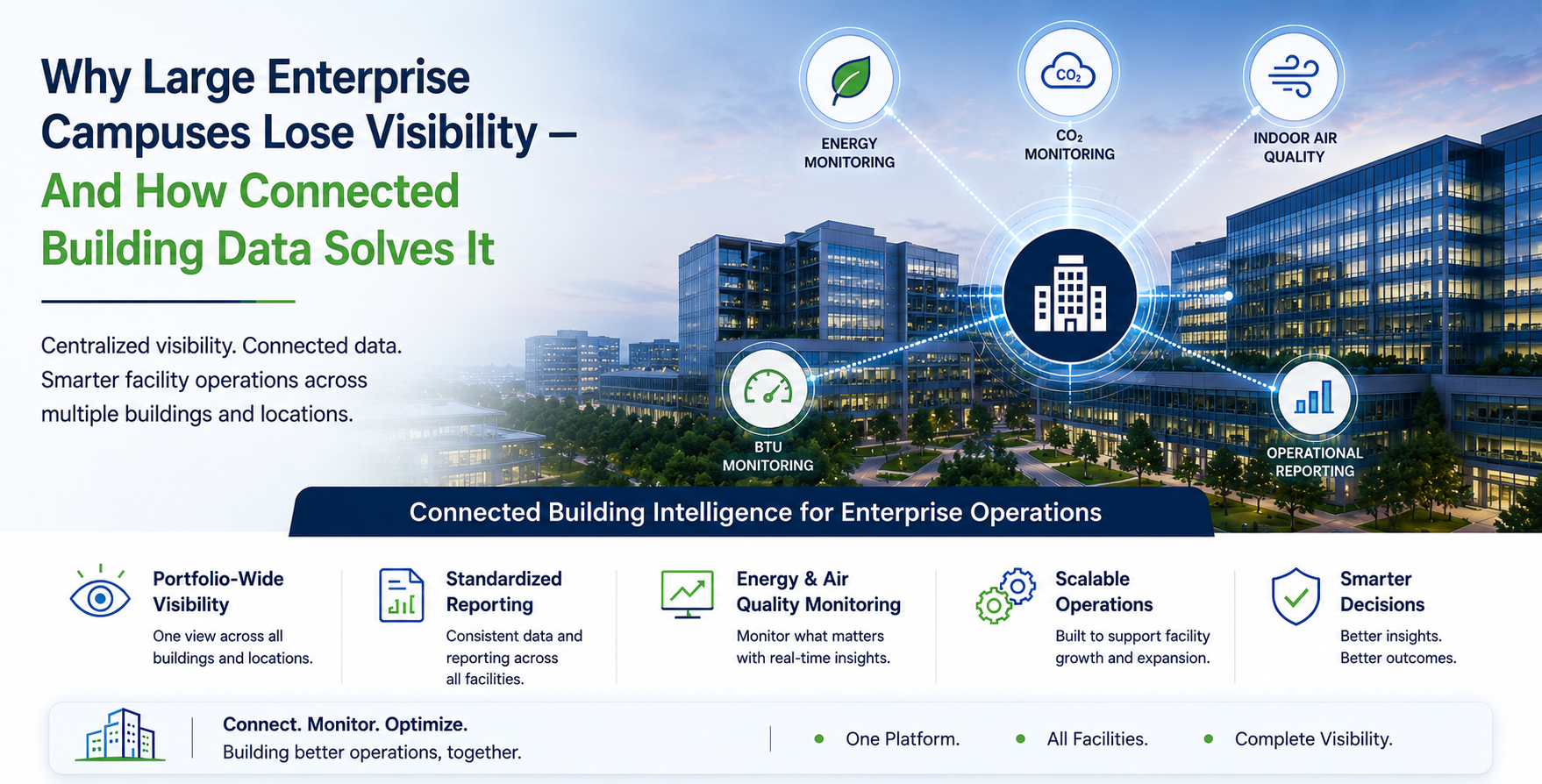
EnSmart's EnNode Gateway connected to each existing BMS using open protocols — BACnet and Modbus — standardized the data points into a common tag structure, and published everything into EnSmart's I³IOT layer. Energy data, BTU metering, CO₂ readings, and indoor air quality — all collected, all unified, all visible in one place.
The layer above never had to understand multiple vendor languages. It only ever spoke one.
No campus went offline. No existing BMS was touched. No site team had to change how they worked.
What the rollout actually looked like
This was not a clean, linear deployment.
It started in 2018 with the first campus at TCS Magnum. Every BMS exposed data differently. Field names did not match. Point lists were incomplete. Some systems had firmware versions that required custom mapping before a single data point could be normalized correctly.
Each campus taught the integration layer something the next campus benefited from.
By Campus 4, the data mapping process was faster. By Campus 8, onboarding that once took months was completing in weeks. The architecture did not just scale — it got smarter with every building added.
Seven years later, eleven campuses are live across India. That compounding effect is what continuous deployment across a growing enterprise footprint actually produces.
What changed on Arjun's Tuesday morning
Seven years. One architecture. A compounding advantage.
This project was not completed in a single go.
It was not a six-month deployment with a handover ceremony and a signed completion certificate.
It was seven years of continuous work — campus by campus, starting from TCS Magnum in 2018 and expanding across India through 2025 and into 2026 — building an integration layer that got stronger and faster with every deployment.
That is what multi-campus IBMS integration actually looks like in the real world.
Not a product. Not a one-time installation.
A system that compounds over time.
The biggest impact was not reporting speed — it was the ability to detect inefficiencies across the entire estate that were previously invisible. Anomalies that lived quietly inside one campus's local BMS, never seen by anyone at the portfolio level, became visible the moment data was unified.
"The campuses did not change. The conversation between them changed. And that conversation is what changed everything."
What enterprise facility leaders can learn from this
- Do not assume an expanding campus portfolio automatically scales operations
- Collect data from existing systems — there is no need to replace infrastructure that is already working
- Standardized building data improves visibility across teams, cities, and time zones
- Energy, IAQ, CO₂, and BTU data belong in one view — not scattered across separate systems
- Distributed enterprise footprints require connected information flows — not just better individual systems
- Open protocols simplify long-term scalability and reduce vendor lock-in
Technology matters.
But operational visibility matters even more.
Is your campus Arjun's campus?
Most enterprise campuses do not realize they have a visibility problem until reporting becomes impossible to scale. By that point, the fragmentation has usually been building for years — quietly, campus by campus, vendor by vendor.
This is where most enterprise energy visibility programs begin to break.
If you manage more than one building — and different buildings run on different BMS vendors — you are already living some version of Arjun's Tuesday morning.
Maybe it is energy reports. Maybe it is IAQ data. Maybe it is BTU metering that exists on some campuses and not others. Maybe it is inefficiencies that exist somewhere across your multi-campus estate but remain invisible because no system is looking at all of them at once.
Most enterprises don't have a building problem. They have a visibility problem they haven't named yet.
Related reading in the EnSmart BMS Library: