Think of your building like a cricket match
Imagine a high-stakes Test match at the Chepauk in Chennai. Eleven players on the field. A wicketkeeper. A slip cordon. Mid-on and mid-off positioned just right. The bowler runs in. Every fielder adjusts in real time — to the batsman's stance, the pitch condition, the score, the over count.
Who makes all that happen? The captain.
The captain doesn't bowl every ball. Doesn't take every catch. But every time conditions change — a left-hander comes in, the ball starts reversing, light becomes tricky — the captain reads the situation and repositions the entire team instantly.
That captain is your BMS.
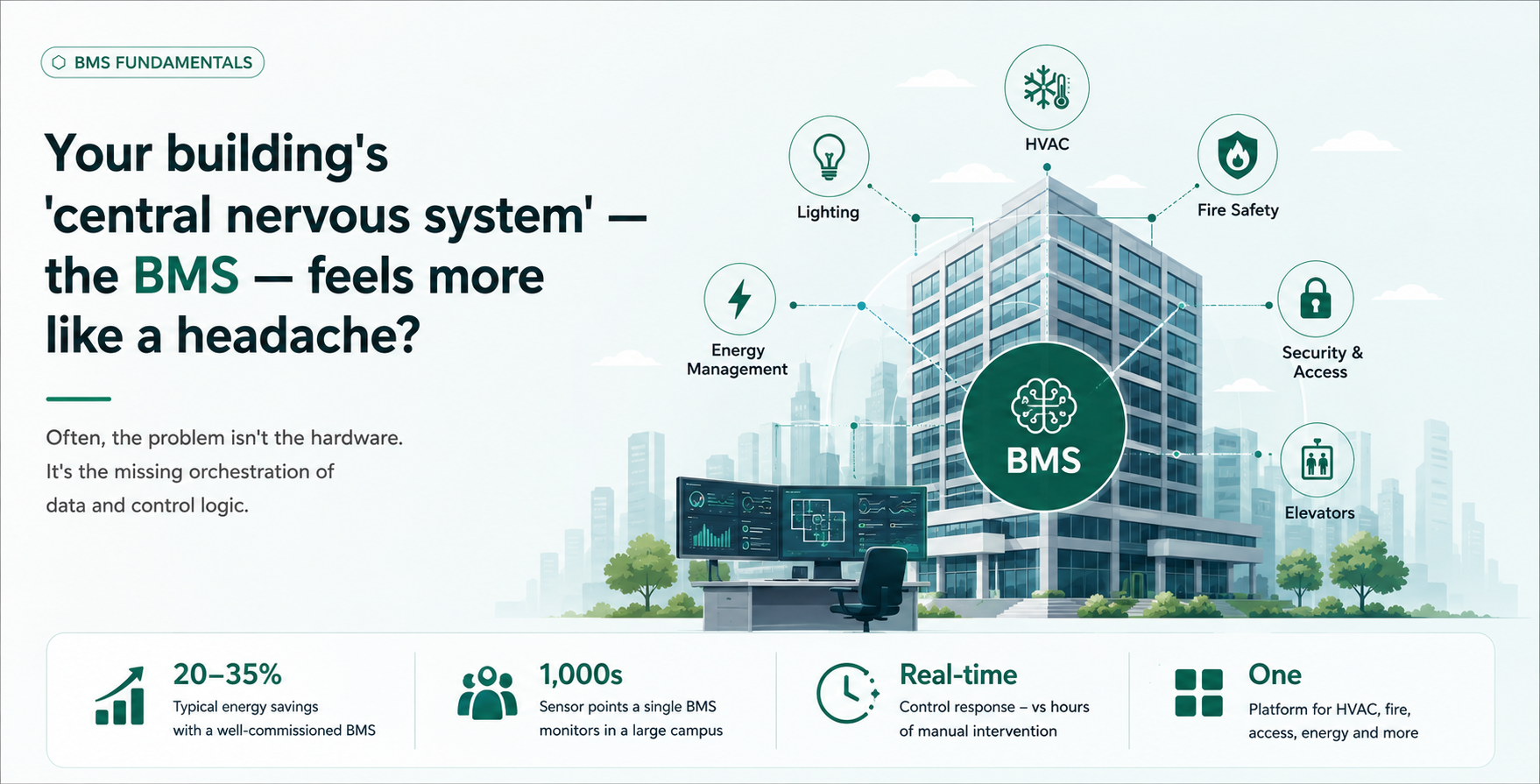
The players are your building systems — HVAC, lighting, fire detection, access control, energy meters. Each one does their job. But without the captain reading conditions in real time and making intelligent decisions, the team plays blind. A chiller keeps running at full capacity when the building is half-empty. An AHU fights a fire damper. An exhaust fan spins all night in an empty basement.
The BMS is the captain that prevents all of this — automatically, continuously, without anyone picking up the phone.
From a cricket field to your building — the full map
| On the cricket field | In your building (BMS) |
|---|---|
| Captain | BMS Central Server / Operator Workstation |
| Players (bowler, keeper, fielders) | HVAC (AHUs, Chillers), Lighting, Fire Safety, Security, Elevators |
| Match strategy & field placements | Control Sequences, Schedules, Setpoints |
| Captain's hand signals to fielders | Control Signals (0–10V, 4–20mA, DI/DO) |
| Scoreboard, pitch report, weather alert | Sensor Inputs (Temperature, Humidity, CO₂, Occupancy) |
| A flawless innings — no extras, no dropped catches | Optimal Building Performance (Comfort, Efficiency, Safety) |
| A dropped catch or misfield | Alarms, Faults, Equipment Deviations |
Scale this to a real Indian building
At home, you manually switch on the fan, adjust the AC, turn on the geyser. Simple enough.
Now picture a 15-floor IT park in Whitefield, Bengaluru, with 5,000 employees arriving at 9 AM. Dozens of AHUs. Hundreds of FCUs. Thousands of light fixtures. Multiple chillers and cooling towers. Fire detection zones on every floor. Access control at every entry point.
No captain means chaos — systems running when no one is there, alarms no one notices, energy bills no one can explain.
The BMS steps in as the central brain. It monitors temperature in every zone, adjusts AHU supply air, controls chiller operation based on actual load, switches off lights in unoccupied areas, and integrates with fire alarms to shut down AHUs and open smoke dampers the moment a fire is detected. All of it — automatic. All of it — intelligent.
What a BMS actually does — the seven core functions
Continuously collects data from thousands of sensors — temperature, humidity, CO₂, pressure, flow, energy consumption — plus equipment status (on/off, fault) across every system in the building.
Uses sensor data to automatically adjust systems based on predefined sequences, schedules, and setpoints — starting/stopping equipment, modulating valves and dampers, adjusting fan speeds.
Runs algorithms to improve energy efficiency — demand-controlled ventilation, optimal start/stop, peak load shedding — without sacrificing occupant comfort.
Detects abnormal conditions (high temperature, equipment fault, communication loss) and notifies facility managers immediately through email, SMS, or workstation alerts.
Manages building operations by time-of-day, day-of-week, and holiday calendars — ensuring systems run only when actually needed.
Logs historical data, generates reports on energy consumption and equipment performance, and provides insights that facility managers can actually act on.
Acts as a common platform to unify HVAC, lighting, power, fire, security, and vertical transport — so all systems speak one language and act as one intelligent building.
A BMS is only as good as what's behind it
How a BMS is structured — the architecture
EnSmart's SmartNova Platform has been deployed across 200+ buildings in India — IT parks, pharma, hospitals, data centres. Our Indian engineering team visits your site, audits your existing systems, and gives you a real deployment estimate in 24 hours. No pitch deck. Just numbers.