How Does an AHU Cool and Condition Air?
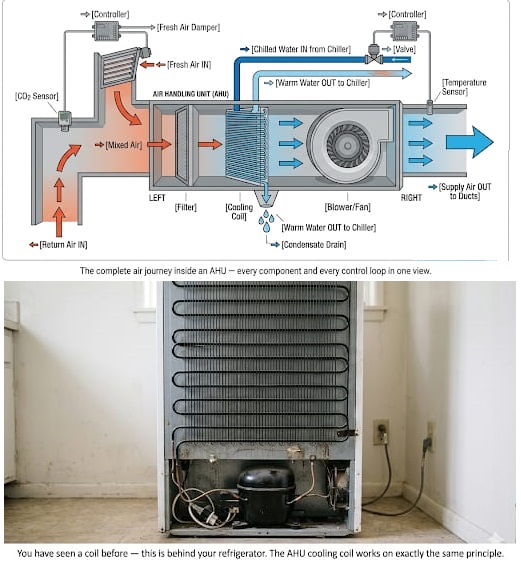
How Does an AHU Cool and Condition Air?
The Complete Story — From Your Water heater/Solar Water Heater to a 10-Floor Building
Category: HVAC Systems
URL: /bms-library/qa/how-does-ahu-cool-and-condition-air
Tags: AHU, cooling coil, heat exchange, chilled water valve, CO2 sensor, fresh air damper, BMS control, PID
Related: What Is an AHU, What Is PID Control, What Is a CO2 Sensor, What Is FBD
One-Line Understanding
An AHU cools and conditions air by passing it over a cold water coil, automatically controlling temperature through a motorised valve and air quality through a fresh air damper — all managed by a DDC controller running 24 hours without human intervention.
🚿 Start Here — Your Bathroom Teaches This
Every morning. Any Indian home.
You open the hot water tap — too hot.
You open the cold water tap — too cold.
You mix both with your hand.
Your skin feels it. Your brain decides — "this is right."
Your hand adjusts the tap until perfect.
You did not use a thermometer.
You did not calculate anything.
Skin sensed → Brain decided → Hand adjusted.
This process — two temperatures meeting, one conditioning the other — is called Heat Exchange.
This heat exchange between chilled water and warm air is the core AHU working principle — and it runs the same way in every AHU across every building, from a small office in Coimbatore to a hospital tower in Dubai.
This is exactly what happens inside every AHU in every building. Every single time. Just at a much larger scale — and done automatically by sensors and a controller instead of your hand and brain.
🏢 Scale It to a Building
| In Your Bathroom | In an AHU |
|---|---|
| Hot water from geyser | Chilled water from chiller plant |
| Cold water from tap | Warm return air from rooms |
| Your hand mixing both | Cooling coil — where they meet |
| Your skin sensing temperature | Temperature sensor in duct |
| Your brain deciding | DDC Controller |
| Your hand adjusting the tap | Motorised chilled water valve |
| Comfortable bath water | Conditioned cool supply air |
❄️ What Is the Cooling Coil in AHU? — The Refrigerator Teaches This
Go to the back of your home refrigerator right now.
You will see pipes — running back and forth, up and down, covering the back panel in a pattern. Cold fluid flows inside these pipes. Room air passes over them. Air gives up its heat to the cold pipes. Air comes out cooler.
That arrangement of pipes is called a coil.
The AHU cooling coil works identically:
Chiller produces water at 6–8°C
        ↓
Chilled water flows through pipes into AHU
        ↓
Inside AHU — pipes are bent into rows
spanning the full height and width of the unit
(If AHU is 5 feet tall — coil covers all 5 feet)
        ↓
Warm room air passes over these cold pipes
        ↓
Heat transfers FROM air INTO cold water
        ↓
Air temperature drops from 28–32°C to 12–16°C
Water temperature rises from 8°C to 12–14°C
Water returns to chiller — chiller removes heat — cycle repeats
One more thing happens here automatically — dehumidification.
When air cools below its dew point, moisture condenses on the cold coil surface. Water droplets form, drip into a drain pan, and flow out through the condensate drain pipe. The same reason a cold glass of water sweats on a humid Chennai afternoon — condensation on a cold surface.
Cooling and dehumidification happen simultaneously. One coil. Two jobs.
🔄 Step-by-Step — Air Journey Inside the AHU
Step 1️⃣ — Air Mixing (Return Air + Fresh Air)
Two types of air enter the AHU together:
Return air — air coming back from the rooms. Already used. Warm. Carrying CO2 from people breathing. This is the warm water in your bathroom analogy.
Fresh air — outside air brought in through a motorised damper. This is the cold water in your bathroom analogy.
Both mix inside the AHU — their proportion controlled by the CO2 sensor reading (explained in Step 6).
Step 2️⃣ — Filter (Protection Before Conditioning)
Before the mixed air reaches the cooling coil — it passes through a filter.
Think of it like a mosquito net on your window. Air passes through freely. Dust and particles are caught.
Why filter before the coil?
If dust settles on the coil surface — it acts as insulation. Heat exchange efficiency drops. The AHU works harder, uses more energy, cools less. The filter protects the coil. The filter also protects the lungs of the people in the building.
How BMS monitors the filter:
A differential pressure sensor or switch measures the pressure difference across the filter. Clean filter = low resistance = low differential pressure. Choked filter = high resistance = high differential pressure = BMS raises alarm: "Filter needs replacement."
Step 3️⃣ — Cooling Coil (Heat Exchange Happens Here)
This is where the bathroom analogy becomes real.
Chilled water at 6–8°C flows inside the coil pipes. Warm filtered air at 28–32°C passes over the outside of the pipes. Heat transfers from the warm air into the cold water. Air comes out cool at 12–16°C.
The valve before the coil controls everything — how much chilled water flows through determines how much cooling happens. More water flow = more cooling. Less water flow = less cooling. Exactly like your hand on the hot water tap.
Step 4️⃣ — Motorised Valve (The Automatic Tap)
At home — your hand opens and closes the hot water tap.
In the AHU — a motorised actuated valve does this automatically.
VALVE TYPE:    Ball valve or globe valve with electric actuator
CONTROL:       0–10V or 4–20mA signal from DDC controller AO channel
RANGE:         0% (fully closed) to 100% (fully open)
               Any position in between — 23%, 67%, 81% — exactly
Why motorised and not manual?
A 10-floor office building may have 30 AHUs. Each has a chilled water valve. If someone had to physically walk to each AHU and manually turn a valve based on temperature — that is impossible to maintain consistently.
Instead — the BMS controller sends a signal to each motorised actuator. All 30 valves across all 10 floors are controlled from one panel automatically. The controller adjusts every valve every few seconds. No human involved.
Step 5️⃣ — Blower / Supply Fan (Pushing Air to Rooms)
After the cooling coil — the conditioned air reaches the supply fan (blower).
The fan is driven by a motor connected to a Variable Frequency Drive (VFD) — also controlled by BMS. Fan speed determines how much air reaches the rooms.
More rooms occupied → more cooling demand → fan runs faster
Fewer rooms → less demand → fan slows down → energy saved
The conditioned air exits the fan into the supply air duct — the air-carrying box — and travels through a network of ducts to ceiling diffusers in every room on the floor.
Step 6️⃣ — CO₂ Sensor and Fresh Air Damper (Air Quality Control)
In the return air duct — a CO₂ sensor monitors the air coming back from the rooms.
As people work and breathe — CO₂ builds up. The sensor reads this continuously and tells the controller.
CO₂ below 800 ppm:
  Rooms well ventilated
  Fresh air damper stays at minimum (saves energy)
CO₂ rises above 1000 ppm:
  People exhaling more CO₂ than fresh air replaces
  Controller opens fresh air damper more
  More outside air enters → dilutes CO₂ → levels drop
CO₂ above 1200 ppm:
  Alarm raised on BMS dashboard
  Maximum fresh air introduced
  Facility manager notified
The fresh air damper — like the chilled water valve — modulates automatically. Not just open or close. Any position. Any percentage. Based on actual CO₂ level at that moment.
🧠 Who Controls Everything? — The Brain
DDC Controller — Direct Digital Controller
READS (Inputs):
  Supply air temperature sensor    →  AI (°C)
  Return air CO₂ sensor            →  AI (ppm)
  Filter differential pressure     →  AI or DI (Pa)
  Fan run status feedback          →  DI (running/stopped)
  Fire alarm signal                →  DI (normal/alarm)
CONTROLS (Outputs):
  Chilled water valve position     →  AO (0–100%)
  Fresh air damper position        →  AO (0–100%)
  Supply fan start / stop          →  DO
  Fan speed via VFD                →  AO (Hz)
The controller runs FBD logic — Function Block Diagram — the programmed sequence that connects every sensor reading to every control output. This logic runs every few seconds, 24 hours, 365 days, without stopping.
⚙️ Control Logic — Simple View
Temperature control:
  SAT sensor reads > setpoint  →  Open CHW valve more  →  More cooling
  SAT sensor reads < setpoint  →  Close CHW valve more  →  Less cooling
  SAT sensor reads = setpoint  →  Hold valve position   →  Stable
CO₂ control:
  CO₂ > 800 ppm  →  Open fresh air damper more  →  Dilute CO₂
  CO₂ < 800 ppm  →  Close fresh air damper more  →  Save energy
Fan safety:
  Fire alarm active   →  Fan stops immediately
  No run feedback     →  Fault alarm raised
  Filter DP high      →  Filter choked alarm
Everything is automatic.
No engineer walks between AHUs.
No manual valve adjustments.
No guessing.
👤 Human Body vs AHU — The Complete Mapping
| Human Body | AHU System |
|---|---|
| Skin — senses temperature | Temperature sensor in duct |
| Brain — processes and decides | DDC Controller |
| Hand — adjusts the tap | Motorised chilled water valve |
| Hot water from geyser | Chilled water from chiller |
| Cold water from tap | Return air from rooms |
| Mixed water at right temperature | Conditioned supply air |
| Lungs — need fresh air | CO₂ sensor + fresh air damper |
| Nose — detects bad air | CO₂ and air quality sensors |
| Body sweating to cool down | Cooling coil + condensate drain |
⚠️ Common Mistakes in AHU Control
| Mistake | What Happens | Fix |
|---|---|---|
| Temperature sensor placed near supply diffuser | Reads supply air not room air — wrong control | Move sensor to return air duct or occupied zone |
| CHW valve not modulating — fully open or closed | Temperature hunts — too cold then too warm | Check valve actuator and controller AO signal |
| CO₂ sensor in supply duct | Reads fresh diluted air — always shows low CO₂ — never opens damper | Move to return air duct |
| Filter not changed — choked | Airflow drops — cooling drops — energy rises | Check filter DP monthly — replace when alarm activates |
| PID gain set too high | AHU oscillates — temperature never settles | Reduce P gain — re-tune PID on site |
| No fresh air at night | Security and cleaning staff breathing CO₂-rich air | Set minimum fresh air damper position even in unoccupied mode |
🧩 Memory Hook
Air enters → FILTER cleans it
             COIL cools it  (chilled water takes the heat)
             VALVE controls how much cooling  (motorised tap)
             DAMPER controls how much fresh air  (CO₂ driven)
             FAN pushes it out  (VFD controlled speed)
             SENSOR tells the truth  (temperature, CO₂)
             CONTROLLER decides everything  (the brain)
Your bathroom taught you all of this.
You just did not know it was called an AHU.
📌 One-Line Concept
The AHU is your building's lungs and body temperature regulator — it breathes in fresh air, removes heat, filters dust, and delivers conditioned air to every room — automatically, continuously, intelligently.
🎯 Why This Page Is the Most Important in the Library
This single page connects:
- Sensors — temperature, CO₂, filter DP
- Controller — DDC, brain of the system
- Signals — AI, AO, DI, DO
- Valve — motorised actuator, modulating control
- FBD — the logic connecting all of it
- PID — how temperature is controlled precisely
- HVAC — what conditioning really means
- Energy — VFD, DCV, demand-based control
EnSmart BMS Knowledge Library SEO anchors: "AHU working principle", "how AHU cools air", "cooling coil in AHU". © 2026 EnSmart Controls. All rights reserved.
Related Topics
- What is BMS integration? — how a BMS connects with VFDs, energy meters, BACnet/Modbus devices and other building systems
- How to design a BMS system step by step — the complete BMS design methodology covering site survey, IO list, controller selection, sequence of operations
- What is a Building Management System (BMS)? — fundamentals of BMS controls and architecture for HVAC, lighting, energy and access
- What is BMS commissioning? — the disciplined commissioning process that turns a BMS install into a working building brain
- Browse all General topics — more from this section of the EnSmart BMS Library