What Is an Energy Management System (EMS)? — Beyond Just BMS
Copied to clipboard ✓
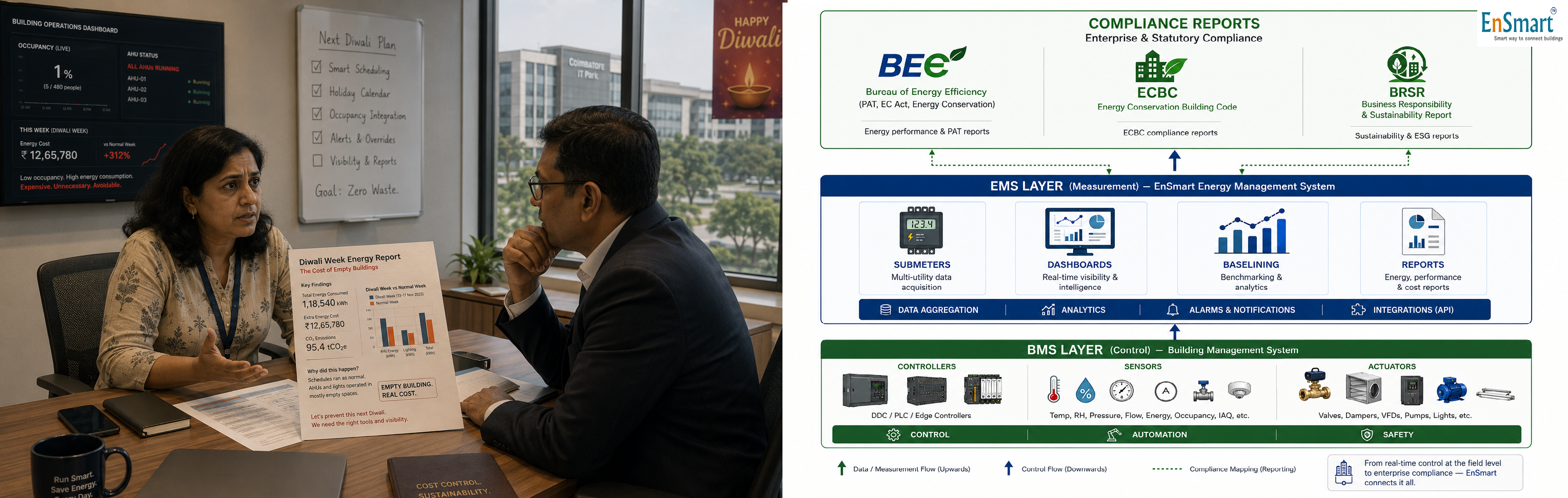
A Coimbatore IT-Park, Two Days After Diwali
Anitha is the facility manager of a four-floor IT park in Coimbatore. The Diwali holiday week ended yesterday. Today she has the post-holiday energy report on her desk. The number is shocking. The building was empty for five days. Not a single tenant came in. Not a single laptop was switched on. And yet — the AHU schedule kept running. The chillers kept staging. The pumps kept circulating. The lighting kept its evening sweep. The bill for those five empty days is heavy. Anitha's BMS technically runs all of this. But the BMS control loop did its job — it ran the equipment as scheduled. The BMS measurement loop never said: "the building is empty; consider stopping." That is because most BMS installations have control without measurement. They have hands without eyes. She walks to the CFO. The CFO listens, then asks: "Don't we already have a BMS? Why do we need an EMS too?" It is the right question. The answer separates two layers that most buildings confuse. Every single one of these problems has one solution.The Two Layers — Control vs Measurement
``` BMS — Building Management System ───────────────────────────────────────── Job: control. Switch AHUs on at 7 AM. Modulate dampers based on CO2. Stage chillers based on load. Sequence pumps based on differential pressure. Outputs: setpoints met, equipment runs as designed. What it does NOT do (by design): tell you whether the control was efficient. Whether the building should have run at all on a Sunday. Whether last month's chiller-COP dropped 8 percent versus baseline. ``` ``` EMS — Energy Management System ───────────────────────────────────────── Job: measure. Read submeters every minute. Build a baseline of normal consumption. Alert when consumption deviates from baseline. Generate compliance reports for ECBC, BEE, PAT. Show the building manager last week's energy story. Outputs: trends, dashboards, deviation alerts, reports. What it does NOT do (by design): control any equipment. EMS is the eyes; BMS is the hands. The separation is intentional, and it matters for accountability. ```Why the Separation Matters
If the same system both controls and measures, it is judging its own work. Auditors do not trust that. Regulators do not trust that. The CFO should not trust that either. A separate EMS layer reads from independent submeters at the LT panel, the floor distribution board, the chiller plant, the AHU motors, the lighting circuits. The submeter does not know about the BMS schedule. It just records what is consumed, every minute, forever. When the EMS shows the four-floor IT park consumed full energy during Diwali week, the CFO can demand an answer from the BMS — and the BMS cannot hide.What an EMS Actually Reads
The data flow is simple. The discipline is the discipline: ``` EMS reads from: LT panel kWh meter building total Floor-1 distribution kWh per-floor allocation Floor-2 distribution kWh per-floor allocation Chiller plant kWh HVAC sub-total AHU motor kWh (per AHU) AHU efficiency Lighting circuit kWh lighting load DG running kWh generator usage Solar inverter kWh on-site generation EMS computes: Baseline (rolling 30-day, weather-normalised) Deviation alerts (>5 percent above baseline triggers email) Energy KPIs (kWh per sq ft, kWh per employee, EUI) Compliance reports (BEE Form-1, ECBC checklist, PAT M&V) EMS exports: PDF reports (monthly, quarterly) CSV trends (auditor-ready) XBRL filings (BRSR-ready for SEBI-listed entities) ```Why an EMS Pays for Itself
Anitha does the math. If next Diwali the EMS catches the schedule oversight on day-1 instead of day-5, the saving alone covers the EMS cost in a single holiday week. Multiplied across a year of long weekends, festivals, and weekly weekends — the saving is many times the install cost. But the bigger return is not the saved kWh. It is the conversation. The CFO can now ask: "why did we use this much last week?" And someone, somewhere, has the answer. A BMS without an EMS is a car without a fuel gauge. It will run. But you will not know how far it can go, or how much it cost to get there.Related Topics
- What is BMS integration? — how a BMS connects with VFDs, energy meters, BACnet/Modbus devices and other building systems
- How to design a BMS system step by step — the complete BMS design methodology covering site survey, IO list, controller selection, sequence of operations
- What is a Building Management System (BMS)? — fundamentals of BMS controls and architecture for HVAC, lighting, energy and access
- What is BMS commissioning? — the disciplined commissioning process that turns a BMS install into a working building brain
- Browse all Energy Management topics — more from this section of the EnSmart BMS Library
Related Topics
- What is BMS integration? — how a BMS connects with VFDs, energy meters, BACnet/Modbus devices and other building systems
- How to design a BMS system step by step — the complete BMS design methodology covering site survey, IO list, controller selection, sequence of operations
- What is a Building Management System (BMS)? — fundamentals of BMS controls and architecture for HVAC, lighting, energy and access
- What is BMS commissioning? — the disciplined commissioning process that turns a BMS install into a working building brain
- Browse all Energy Management topics — more from this section of the EnSmart BMS Library
Related Topics
- What is BMS integration? — how a BMS connects with VFDs, energy meters, BACnet/Modbus devices and other building systems
- How to design a BMS system step by step — the complete BMS design methodology covering site survey, IO list, controller selection, sequence of operations
- What is a Building Management System (BMS)? — fundamentals of BMS controls and architecture for HVAC, lighting, energy and access
- What is BMS commissioning? — the disciplined commissioning process that turns a BMS install into a working building brain
- Browse all Energy Management topics — more from this section of the EnSmart BMS Library
Related Topics
- What is BMS integration? — how a BMS connects with VFDs, energy meters, BACnet/Modbus devices and other building systems
- How to design a BMS system step by step — the complete BMS design methodology covering site survey, IO list, controller selection, sequence of operations
- What is a Building Management System (BMS)? — fundamentals of BMS controls and architecture for HVAC, lighting, energy and access
- What is BMS commissioning? — the disciplined commissioning process that turns a BMS install into a working building brain
- Browse all Energy Management topics — more from this section of the EnSmart BMS Library
Was this answer helpful?
✓ Thanks — your feedback was recorded.