Smart Building Solutions in India — What 'Smart' Actually Means
Copied to clipboard ✓
A Hyderabad Sales Lounge, Thirty Seconds to Explain
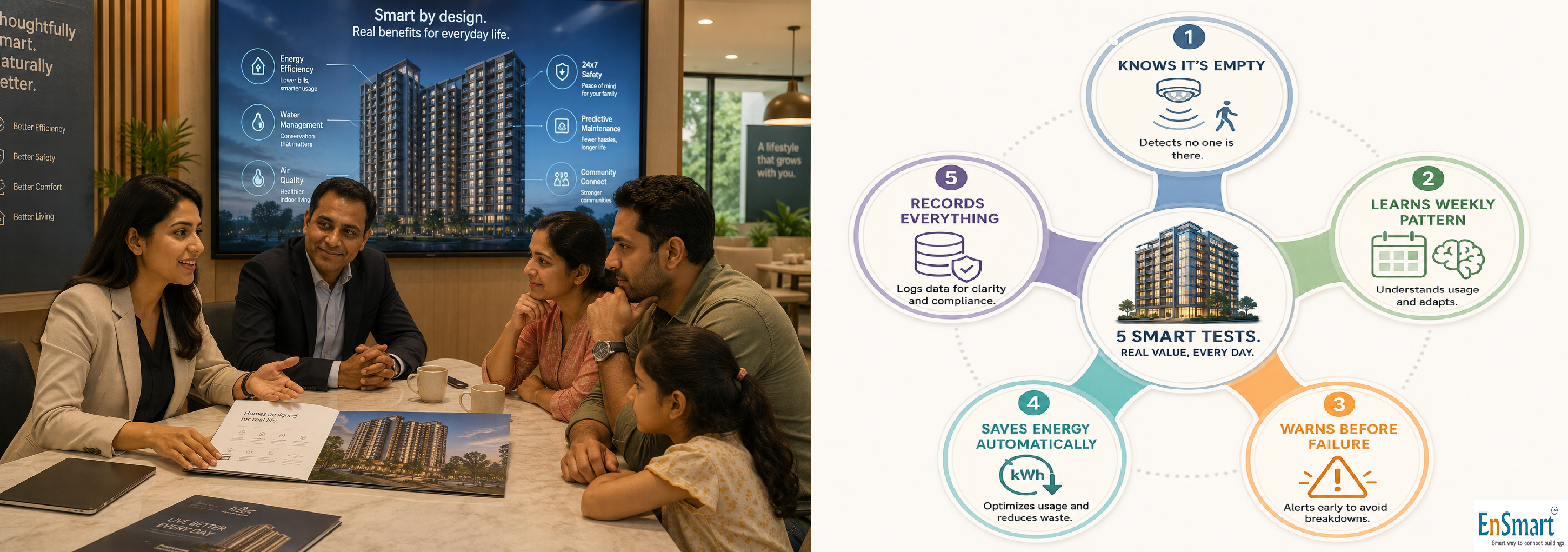
Vidya is the founder of a Hyderabad real-estate developer. Her project is positioned as a smart residential tower. Buyers walk in, listen to the pitch, and ask the same question: "Smart how?" The salesperson points at a Wi-Fi router. Vidya watches the buyer's expression flatten. The pitch needed something better. She brings in Karthik, her MEP head. Karthik is a serious engineer; Vidya asks him to explain in thirty seconds what "smart" means without slipping into jargon. Karthik writes five tests on a single sheet of paper. Every single one of these problems has one solution — five tests every smart building must pass.The Five Tests of a Smart Building
``` Test 1 — Does the building know it is empty? Occupancy sensors in zones, access control counts at gates, CO2 sensors as a proxy for people. If empty, AC and lighting step down. If full, they ramp up. No-one walks the floors to switch things on or off. Test 2 — Does the building learn last week's pattern? The schedule writes itself from observed usage. Monday's 9 AM occupancy ramp is learned, not programmed. Diwali week is recognised as low-occupancy automatically. Test 3 — Does the building warn before failure? A pump's vibration drift, a chiller's COP drop, an AHU motor's current creep — caught a week before the fault, not three days after the breakdown. Test 4 — Does the building save energy automatically? The fresh-air damper modulates by CO2. The lighting dims by daylight. The chiller setpoint resets by load. Without a human asking it to. Test 5 — Does the building record everything? Every sensor reading, every actuator command, every alarm, every overrride — all stored, time-stamped, query-ready. Two years from now, the building can answer "what happened on March 14, 2024 at 10:47 AM?" ``` A building that passes all five is genuinely smart. A building that passes two or three is partially smart. A building with only Wi-Fi is not smart at all.Smart in India — The Local Flavour
Indian buildings have specific smart-building requirements that Western brochures often miss: ``` Indian condition Smart response ───────────────────────────────────────────────────────────── Monsoon humidity Dehumidification logic on AHUs Coastal salt air Corrosion-aware materials, IP-66 panels Power cuts Automatic DG transfer, UPS-backed BMS Extended festivals Holiday calendars (Diwali, Pongal, Eid, Holi) Multi-tenant buildings Per-tenant energy submetering and billing Domestic water scarcity Tank-level monitoring, leak detection, recycle tracking Air quality variation AQI and CO2 driven fresh-air control Open-protocol expectation BACnet IP / Modbus, no vendor lock ``` A smart building in India is not a copy of a Dubai tower or a Singapore mall. It is one that responds to Indian seasons, Indian festivals, Indian tariff structures, and Indian regulatory frameworks like GRIHA, IGBC, and ECBC.How Vidya Closes the Buyer
Karthik's five-test answer becomes Vidya's pitch. The salesperson now demonstrates one test at a time on a sample apartment: ``` "Watch — when the room is empty, the AC steps to 26 setpoint and the lights dim. The schedule runs from your access card, not from a clock. The energy you used last month is on the tenant portal, by appliance category." ``` The buyer sees the smartness in action — not on a brochure. Smart is not Wi-Fi. Smart is when the building does the work that a watchman used to do — and learns to do it better every week.Related Topics
- What is BMS integration? — how a BMS connects with VFDs, energy meters, BACnet/Modbus devices and other building systems
- How to design a BMS system step by step — the complete BMS design methodology covering site survey, IO list, controller selection, sequence of operations
- What is a Building Management System (BMS)? — fundamentals of BMS controls and architecture for HVAC, lighting, energy and access
- What is BMS commissioning? — the disciplined commissioning process that turns a BMS install into a working building brain
- Browse all BMS Fundamentals topics — more from this section of the EnSmart BMS Library
Related Topics
- What is BMS integration? — how a BMS connects with VFDs, energy meters, BACnet/Modbus devices and other building systems
- How to design a BMS system step by step — the complete BMS design methodology covering site survey, IO list, controller selection, sequence of operations
- What is a Building Management System (BMS)? — fundamentals of BMS controls and architecture for HVAC, lighting, energy and access
- What is BMS commissioning? — the disciplined commissioning process that turns a BMS install into a working building brain
- Browse all BMS Fundamentals topics — more from this section of the EnSmart BMS Library
Related Topics
- What is BMS integration? — how a BMS connects with VFDs, energy meters, BACnet/Modbus devices and other building systems
- How to design a BMS system step by step — the complete BMS design methodology covering site survey, IO list, controller selection, sequence of operations
- What is a Building Management System (BMS)? — fundamentals of BMS controls and architecture for HVAC, lighting, energy and access
- What is BMS commissioning? — the disciplined commissioning process that turns a BMS install into a working building brain
- Browse all BMS Fundamentals topics — more from this section of the EnSmart BMS Library
Related Topics
- What is BMS integration? — how a BMS connects with VFDs, energy meters, BACnet/Modbus devices and other building systems
- How to design a BMS system step by step — the complete BMS design methodology covering site survey, IO list, controller selection, sequence of operations
- What is a Building Management System (BMS)? — fundamentals of BMS controls and architecture for HVAC, lighting, energy and access
- What is BMS commissioning? — the disciplined commissioning process that turns a BMS install into a working building brain
- Browse all BMS Fundamentals topics — more from this section of the EnSmart BMS Library
Was this answer helpful?
✓ Thanks — your feedback was recorded.