DDC Controller India — Why Indian-Made Controllers Now Match Imports on Specs and Beat Them on Speed
Copied to clipboard ✓
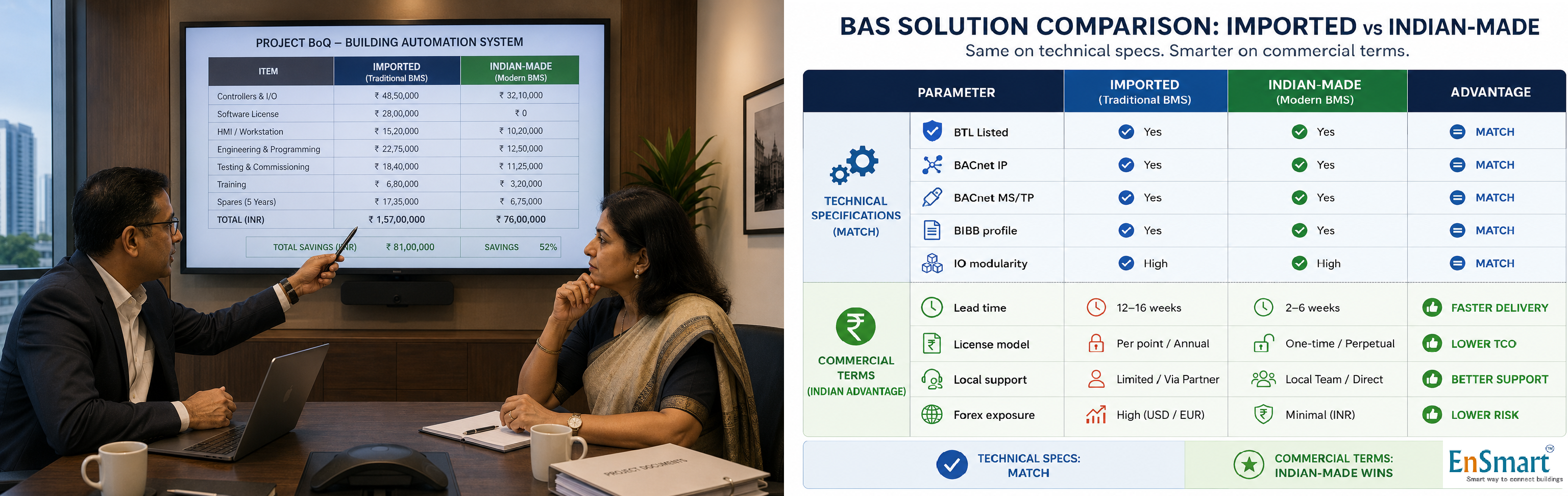
A Mumbai Procurement Review, a Difficult Question
Ramesh is the senior procurement manager at a Mumbai mall developer. For fifteen years, his BoQ has named one or two imported brands for DDC controllers. That is what consultants specified, what the construction team trusted, what the bank financed. This Tuesday, the CFO calls a project review. "On the last six projects, we paid 12 percent forex premium and 18 percent import duty on the BMS hardware. That is one and a half projects' margin. Are we still buying right?" Ramesh defends the choice — "the imported brands have BTL listings, BACnet support, the consultant approved them, the construction team is trained on them." The CFO listens, then asks the next question: "And the Indian-made ones in 2026 — do they have the same approvals?" Ramesh promises to check. Every single one of these problems has one solution — a side-by-side technical comparison, not a habit.The Specs Are the Same
The BMS hardware standards are written by ASHRAE, BTL, ISO. They are not specific to any country of origin. An Indian-made DDC controller in 2026 carries: ``` Compliance Status on Indian-made controllers ───────────────────────────────────────────────────────── BTL Listed Yes, with PICS document published ASHRAE 135 (BACnet) Yes, BACnet IP and BACnet MS/TP ISO 16484-5 Yes BIBBs supported Discovery, Read, Write, COV, Schedule, Calendar, Event Notification, Alarm and Event, Trending CE marking Yes RoHS compliant Yes 21 CFR Part 11 ready Yes (audit trail, electronic signature) ``` These are not aspirations. They are the same shipping documents that imported controllers ship with.What Differs — Always in the Buyer's Favour
The differences are commercial and operational: ``` Procurement reality Imported Indian-made ────────────────────────────────────────────────────────────── Lead time for spare module 4-6 weeks 24-48 hours Lead time for new project 6-10 weeks 2-3 weeks License model Per-point No per-point license Front-end software upgrade Separate fee Included in maintenance Programming engineer cost ₹ premium ₹ standard rate Local engineer availability Major cities 11 cities + partner network Forex / import duty exposure 22-30 percent Zero Documentation language English English + Hindi + Tamil Warranty support response Email queue Phone, same time zone ``` The technical bar is the same. The commercial and operational bar tilts heavily towards Indian-made for any building deployed in India.The Make-in-India Procurement Lever
For government and PSU projects, the Public Procurement (Preference to Make in India) Order — PPP-MII — gives explicit preference to Indian-manufactured products. Class-1 local content (>50 percent local value addition) qualifies for purchase preference. Many Indian-made BMS controllers now meet Class-1 thresholds. For private projects, the lever is direct cost. On a typical 200-controller mid-rise project: ``` Imported brand BoQ: controllers + cables + license = X plus 18 percent duty + 4 percent forex hedge total ≈ 1.22 X Indian-made BoQ: controllers + cables + license = 0.85 X total = 0.85 X Project saving ≈ 30 percent on BMS hardware ``` That saving funds either tighter sub-metering, better cleanroom monitoring, or simply margin recovery.What to Demand in the Specification
A consultant who wants an Indian-made BMS — without naming brands — writes the specification on technical and commercial criteria: ```- BTL Listed; PICS document publicly available.
- BACnet IP and BACnet MS/TP, native (per the three field tests).
- Spare module lead time ≤ 72 hours to project city.
- No per-point software license. Front-end upgrade included
- 21 CFR Part 11 audit trail and electronic signature
- Programming portable to any BACnet integrator.
Related Topics
- What is BMS integration? — how a BMS connects with VFDs, energy meters, BACnet/Modbus devices and other building systems
- How to design a BMS system step by step — the complete BMS design methodology covering site survey, IO list, controller selection, sequence of operations
- What is a Building Management System (BMS)? — fundamentals of BMS controls and architecture for HVAC, lighting, energy and access
- What is BMS commissioning? — the disciplined commissioning process that turns a BMS install into a working building brain
- Browse all DDC Controllers topics — more from this section of the EnSmart BMS Library
Related Topics
- What is BMS integration? — how a BMS connects with VFDs, energy meters, BACnet/Modbus devices and other building systems
- How to design a BMS system step by step — the complete BMS design methodology covering site survey, IO list, controller selection, sequence of operations
- What is a Building Management System (BMS)? — fundamentals of BMS controls and architecture for HVAC, lighting, energy and access
- What is BMS commissioning? — the disciplined commissioning process that turns a BMS install into a working building brain
- Browse all DDC Controllers topics — more from this section of the EnSmart BMS Library
Related Topics
- What is BMS integration? — how a BMS connects with VFDs, energy meters, BACnet/Modbus devices and other building systems
- How to design a BMS system step by step — the complete BMS design methodology covering site survey, IO list, controller selection, sequence of operations
- What is a Building Management System (BMS)? — fundamentals of BMS controls and architecture for HVAC, lighting, energy and access
- What is BMS commissioning? — the disciplined commissioning process that turns a BMS install into a working building brain
- Browse all DDC Controllers topics — more from this section of the EnSmart BMS Library
Related Topics
- What is BMS integration? — how a BMS connects with VFDs, energy meters, BACnet/Modbus devices and other building systems
- How to design a BMS system step by step — the complete BMS design methodology covering site survey, IO list, controller selection, sequence of operations
- What is a Building Management System (BMS)? — fundamentals of BMS controls and architecture for HVAC, lighting, energy and access
- What is BMS commissioning? — the disciplined commissioning process that turns a BMS install into a working building brain
- Browse all DDC Controllers topics — more from this section of the EnSmart BMS Library
Was this answer helpful?
✓ Thanks — your feedback was recorded.