Programming Tools in BMS — Why They Have Stayed Locked, and What Open Looks Like
Copied to clipboard ✓
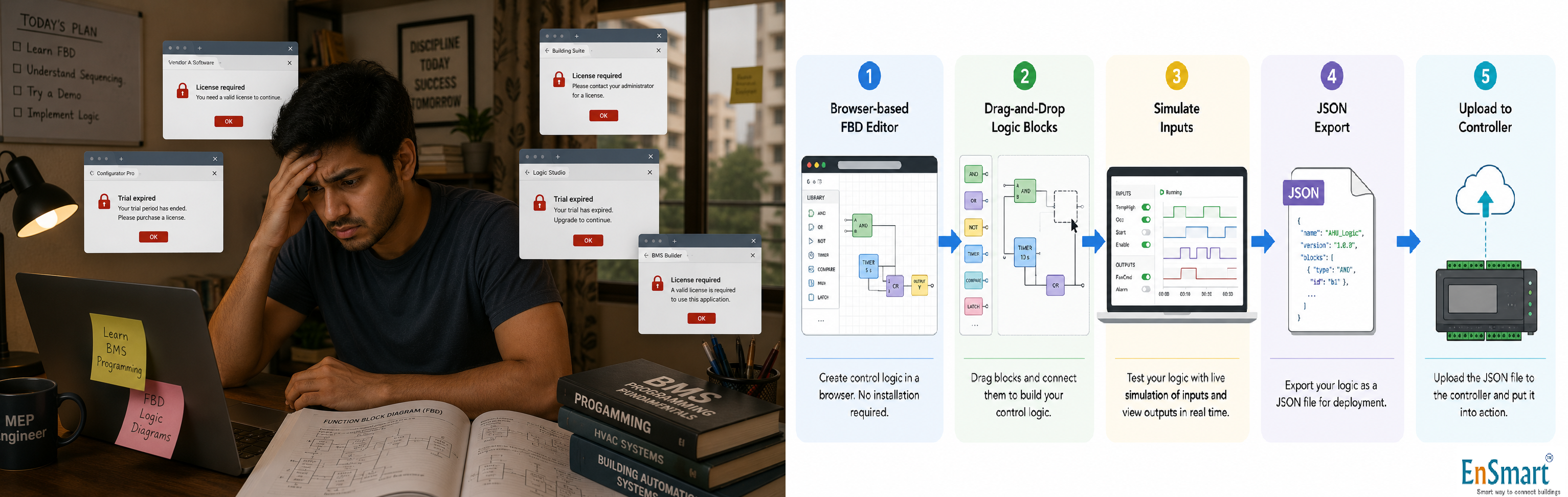
A Bengaluru Apartment, a Laptop, a Locked Door
Karthik graduated as an MEP engineer last year. He works at a consultancy in Bengaluru by day and reads about BMS programming at night. He wants to learn function block diagrams. He has watched 40 hours of YouTube videos. He understands PID. He understands logic gates. He understands schedules and calendars. What he cannot do is open the actual programming tool to practise. ``` Tool 1 — paid license + USB dongle + training course (₹ in lakhs) Tool 2 — vendor partner program; needs a company sponsorship Tool 3 — bundled with a controller you must already own Tool 4 — closed beta; not available to engineers below five years experience ``` Karthik writes to a vendor: "I would like to learn your programming tool. I am a fresh engineer." The reply is polite and final: "Our tool is for certified partners only. Please reach out to your employer for a partner agreement." This is not Karthik's problem. This is the BMS industry's problem — and it has lasted thirty years. Every single one of these problems has one solution — open programming tools.Why Programming Tools Stayed Locked
For decades, the BMS industry treated programming tools as a moat: ``` The vendor playbook on programming tools ─────────────────────────────────────────- Make the tool proprietary. No one else can read or write
- Tie the tool to the controller hardware via dongle or license.
- Charge for training. Treat training certification as a gate
- Limit the tool to certified partners. Refuse direct sales
- Keep the file format closed. Logic written in tool A cannot
What Open Programming Tools Look Like
The next generation of BMS programming tools is built on three principles: ```- Browser-based — no install, no dongle, no admin access
- Free for learning — no certification gate. A fresher can
- Portable — logic exports as JSON or a similar open format.
The Industry-Wide Effect
Open programming tools change four things at once: ``` For new engineers Skill barrier drops from 18 months to 1 weekend. Practical experience replaces theory-only learning. For consultants Larger pool of trained programmers means faster project delivery and competitive bids. For end customers The integrator who quoted high cannot hold the project hostage — another integrator can read the same JSON and continue the work. For the BMS industry More projects get programmed, fewer get stuck waiting for the one programmer who happened to be certified on the brand. ```Why This Matters Now
India is building. Buildings need BMS. BMS needs programmers. The traditional gate — paid license, dongle, certification — produces fewer programmers than the country needs. The open path produces more. When a fresher in Coimbatore can practise FBD on a Sunday afternoon, the country's engineering capacity grows by a quiet step. Multiplied across a thousand freshers, the industry stops being supply-constrained. The lock on programming tools is not a technical lock — it is a business model. Open tools dissolve that model. The next generation of Indian BMS engineering is being trained one browser tab at a time.Related Topics
- What is BMS integration? — how a BMS connects with VFDs, energy meters, BACnet/Modbus devices and other building systems
- How to design a BMS system step by step — the complete BMS design methodology covering site survey, IO list, controller selection, sequence of operations
- What is a Building Management System (BMS)? — fundamentals of BMS controls and architecture for HVAC, lighting, energy and access
- What is BMS commissioning? — the disciplined commissioning process that turns a BMS install into a working building brain
- Browse all DDC Controllers topics — more from this section of the EnSmart BMS Library
Related Topics
- What is BMS integration? — how a BMS connects with VFDs, energy meters, BACnet/Modbus devices and other building systems
- How to design a BMS system step by step — the complete BMS design methodology covering site survey, IO list, controller selection, sequence of operations
- What is a Building Management System (BMS)? — fundamentals of BMS controls and architecture for HVAC, lighting, energy and access
- What is BMS commissioning? — the disciplined commissioning process that turns a BMS install into a working building brain
- Browse all DDC Controllers topics — more from this section of the EnSmart BMS Library
Related Topics
- What is BMS integration? — how a BMS connects with VFDs, energy meters, BACnet/Modbus devices and other building systems
- How to design a BMS system step by step — the complete BMS design methodology covering site survey, IO list, controller selection, sequence of operations
- What is a Building Management System (BMS)? — fundamentals of BMS controls and architecture for HVAC, lighting, energy and access
- What is BMS commissioning? — the disciplined commissioning process that turns a BMS install into a working building brain
- Browse all DDC Controllers topics — more from this section of the EnSmart BMS Library
Related Topics
- What is BMS integration? — how a BMS connects with VFDs, energy meters, BACnet/Modbus devices and other building systems
- How to design a BMS system step by step — the complete BMS design methodology covering site survey, IO list, controller selection, sequence of operations
- What is a Building Management System (BMS)? — fundamentals of BMS controls and architecture for HVAC, lighting, energy and access
- What is BMS commissioning? — the disciplined commissioning process that turns a BMS install into a working building brain
- Browse all DDC Controllers topics — more from this section of the EnSmart BMS Library
Was this answer helpful?
✓ Thanks — your feedback was recorded.