Edge Controller vs Field Controller — Where the Brain Should Sit
Copied to clipboard ✓
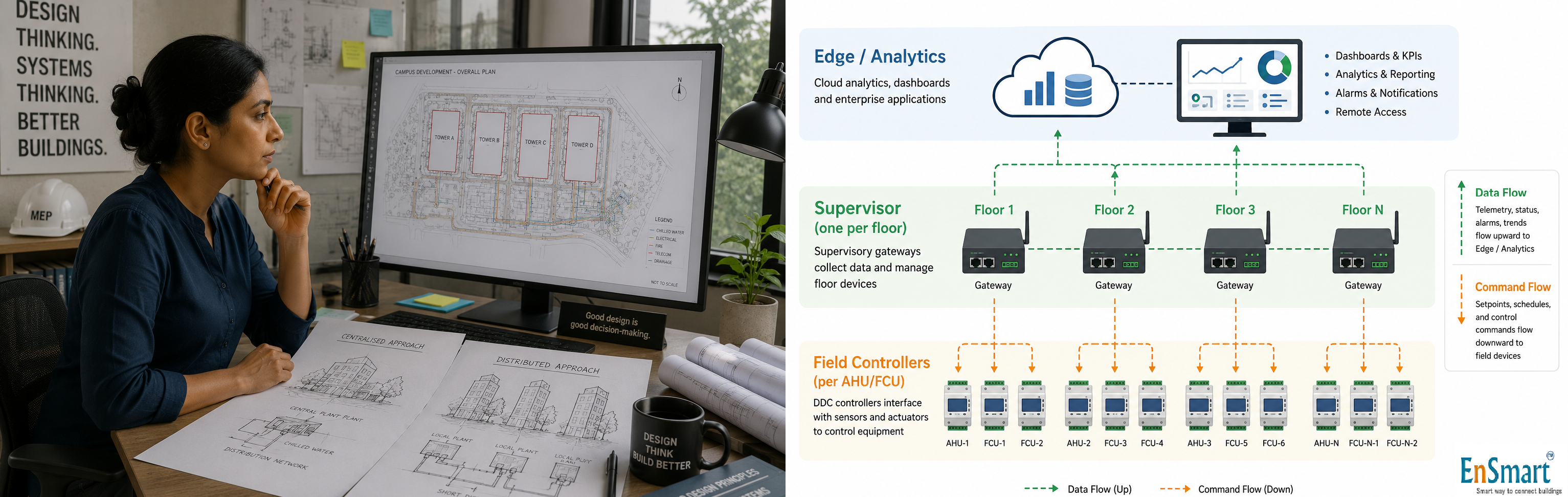
A Bengaluru Architect's Drawing Board
Asha is the MEP architect designing a four-tower IT campus in Bengaluru. Each tower has 12 AHUs. The brief asks for single pane of glass for the whole campus. The build team asks: where does the BMS brain sit? Two architectures are on the table: ``` Architecture A — Centralised One large controller per tower Controls all 12 AHUs from one location Single panel, single network Architecture B — Distributed One small controller at every AHU (12 per tower) Plus one supervisor controller per tower Plus one edge gateway per campus ``` Asha sketches the failure modes for each on the same drawing board. Every single one of these problems has one solution — three-tier architecture with clear responsibilities and clear failure modes.Three Tiers, Three Roles
Modern BMS design separates three responsibilities into three tiers: ``` Tier 1 — Field Controller (one per equipment) Lives at or near the equipment. Reads the equipment's sensors directly. Drives the equipment's actuators directly. Holds the equipment's PID loop and basic interlocks. If communication to higher tiers is lost, the equipment continues to run on local logic — fail-safe. Tier 2 — Supervisor Controller (one per zone or floor) Coordinates field controllers in its zone. Reads zone-level sensors (CO2, occupancy). Implements zone-level sequences (DCV, optimum start). Aggregates alarms from field controllers. If communication to edge is lost, the zone runs autonomously. Tier 3 — Edge Gateway (one per building or campus) Connects the BMS to higher systems (cloud, IT, analytics). Hosts the building front-end and operator graphics. Performs analytics — predictive maintenance, energy KPIs. Stores history for trend and audit. If the cloud is unreachable, the building still runs — Tiers 1 and 2 do not depend on Tier 3. ``` The principle: each tier can fail without breaking the tiers below. Equipment-level safety lives in Tier 1. Zone-level coordination lives in Tier 2. Analytics and visualisation live in Tier 3.Why Centralised Architecture Fails
A single large controller for all 12 AHUs in a tower seems efficient. It is — until it fails. ``` Centralised failure modes ───────────────────────────────────────── Power failure on the central panel All 12 AHUs lose control simultaneously. Manual override on each AHU is the only fallback. Network switch failure Field-level sensors stop reporting. Central controller acts on stale data. Single firmware bug Affects all 12 AHUs at once. No graceful degradation. Maintenance window All 12 AHUs must be coordinated for patching. Building unhappy. Wiring fault A short on one sensor cable can pull down the central controller's power supply, taking 12 AHUs offline. ```Why Distributed Architecture Wins
In a three-tier architecture, the same failures are absorbed: ``` Field controller fails on AHU-3 Other 11 AHUs run normally. AHU-3 falls back to manual or hand-off-auto. Spare module replaces it in hours. Supervisor fails Each AHU's field controller continues its local PID loop. Zone-level features (DCV, optimum start) pause until restored. Building remains comfortable. Edge gateway fails Front-end visualisation is gone. Equipment continues to run. Operator uses local panel HMI. Network switch fails Field controllers in that segment run autonomously. RS-485 daisy chains keep peer-to-peer comms alive. ``` The distributed architecture has more parts, more network complexity, more spare types — and far better fault tolerance.The Recommended Tier Distribution
For a four-tower IT campus like Asha's: ``` Tier 1 — Field controllers 12 AHU controllers per tower × 4 towers = 48 Plus FCU controllers per zone (if FCUs are present) Plus chiller plant PCU per tower Tier 2 — Supervisor controllers 1 per floor × ~16 floors per tower × 4 towers = ~64 Each handles 6-8 field controllers in its zone Tier 3 — Edge gateways 1 per tower (preferred for fault isolation) Or 1 for whole campus (lower cost, single point of failure) ``` The right answer for Asha's campus is one edge gateway per tower, with cross-tower analytics aggregated at a portfolio dashboard. Tower-level failures stay isolated.Communication Patterns
``` Field to Supervisor BACnet MS/TP (RS-485) typical Local, fast, daisy-chain, low cost Up to 32 devices per segment Supervisor to Edge BACnet IP (Ethernet) Tower IT network, IP routing, fast Edge to Cloud HTTPS, MQTT WAN, secure, cloud-tolerant Building does not depend on this link ``` Communication direction is bottom-up for data, top-down for setpoints. Local control is preserved at the lowest tier that can handle it. Where the brain sits is not a packaging question. It is a fault-tolerance question. Three tiers, clear responsibilities, no shared failure modes — that is the architecture an Indian campus deserves.Related Topics
- What is BMS integration? — how a BMS connects with VFDs, energy meters, BACnet/Modbus devices and other building systems
- How to design a BMS system step by step — the complete BMS design methodology covering site survey, IO list, controller selection, sequence of operations
- What is a Building Management System (BMS)? — fundamentals of BMS controls and architecture for HVAC, lighting, energy and access
- What is BMS commissioning? — the disciplined commissioning process that turns a BMS install into a working building brain
- Browse all DDC Controllers topics — more from this section of the EnSmart BMS Library
Related Topics
- What is BMS integration? — how a BMS connects with VFDs, energy meters, BACnet/Modbus devices and other building systems
- How to design a BMS system step by step — the complete BMS design methodology covering site survey, IO list, controller selection, sequence of operations
- What is a Building Management System (BMS)? — fundamentals of BMS controls and architecture for HVAC, lighting, energy and access
- What is BMS commissioning? — the disciplined commissioning process that turns a BMS install into a working building brain
- Browse all DDC Controllers topics — more from this section of the EnSmart BMS Library
Related Topics
- What is BMS integration? — how a BMS connects with VFDs, energy meters, BACnet/Modbus devices and other building systems
- How to design a BMS system step by step — the complete BMS design methodology covering site survey, IO list, controller selection, sequence of operations
- What is a Building Management System (BMS)? — fundamentals of BMS controls and architecture for HVAC, lighting, energy and access
- What is BMS commissioning? — the disciplined commissioning process that turns a BMS install into a working building brain
- Browse all DDC Controllers topics — more from this section of the EnSmart BMS Library
Related Topics
- What is BMS integration? — how a BMS connects with VFDs, energy meters, BACnet/Modbus devices and other building systems
- How to design a BMS system step by step — the complete BMS design methodology covering site survey, IO list, controller selection, sequence of operations
- What is a Building Management System (BMS)? — fundamentals of BMS controls and architecture for HVAC, lighting, energy and access
- What is BMS commissioning? — the disciplined commissioning process that turns a BMS install into a working building brain
- Browse all DDC Controllers topics — more from this section of the EnSmart BMS Library
Was this answer helpful?
✓ Thanks — your feedback was recorded.