Open vs Closed BMS Ecosystems — Five Questions to Ask Before You Specify
Copied to clipboard ✓
A Mumbai Panel Shop, a Specifier's Habit
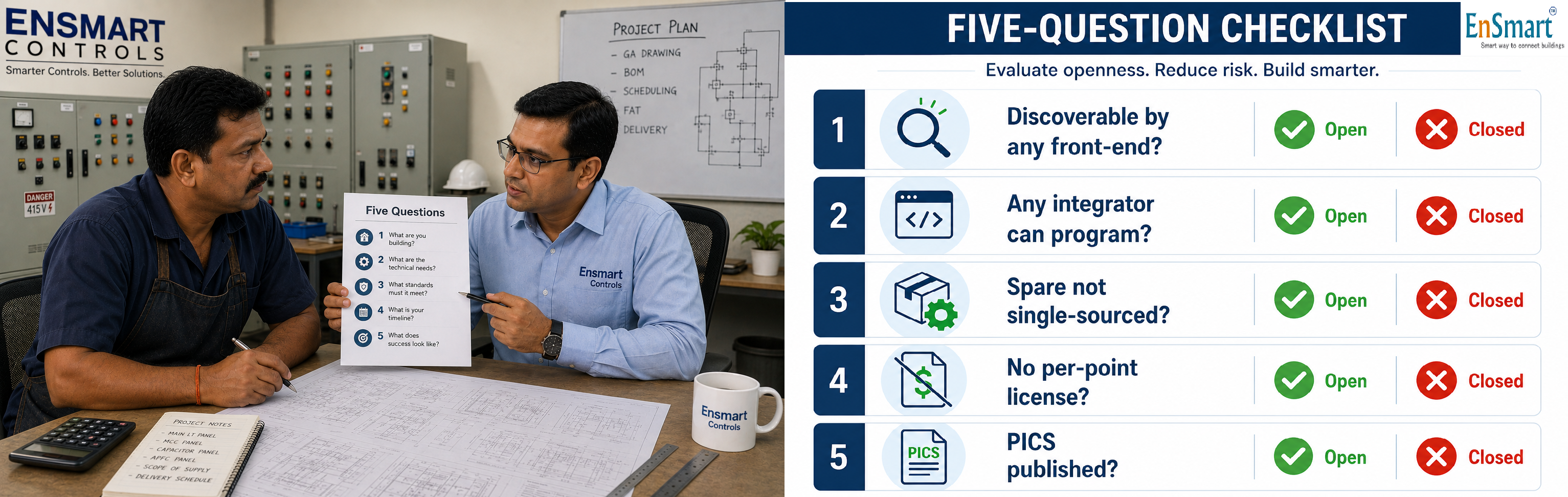
Bharat is a panel builder serving Mumbai commercial high-rises. The latest tender is for a 30-storey tower in BKC. The consultant has dual-specced — "Brand X or equivalent". Bharat reads the equivalent as one of two Indian-made open-protocol options. He prices both routes. Brand X costs noticeably more, comes with longer lead times, and requires a per-point license. The Indian-made option costs less, ships faster, and has no per-point license. The consultant calls. "Bharat, justify the equivalent. Why is the open option as good?" Bharat opens his laptop and types five questions. Every single one of these problems has one solution — five questions that separate open ecosystems from closed ones.The Five Questions
Any consultant evaluating a BMS bid should ask the vendor these five questions in writing, with documented answers: ``` Question 1 — Discovery "Will any BACnet front-end discover all variables on these controllers, or only your own front-end?" Open answer: Any BACnet client discovers everything. We can demonstrate with three different front-ends during the FAT. Closed answer: Discovery works fully only with our workstation. Limited discovery with third-party. Question 2 — Programming Portability "If we replace the BMS integrator after three years, can the new integrator continue programming these controllers without buying your training and licenses?" Open answer: Yes. The programming tool is browser-based, and the FBD logic exports as portable JSON. Any qualified integrator can take over. Closed answer: The new integrator must complete our training program and purchase our programming licenses. Question 3 — Spare Parts "Are spare modules single-sourced from you, or can a panel builder buy compatible modules from a different supplier?" Open answer: The hardware ships through multiple distributors. Spare modules are stocked locally. Closed answer: All spares come from us. Lead time is 4-6 weeks. Question 4 — License Model "Are there per-point, per-controller, or per-front-end license fees? What is the fee schedule for the next ten years?" Open answer: No per-point license. One-time front-end license. Maintenance covers all upgrades. Closed answer: Per-point license for every input/output. Front-end license renews annually. Question 5 — PICS Document "Is your BACnet PICS document publicly downloadable, or under NDA?" Open answer: Public, on our website. Anyone can verify the exact BIBBs and services we support. Closed answer: Available under NDA, after a sales conversation. ``` A vendor who answers "open" to all five operates an open ecosystem. A vendor who answers "closed" to any one of them operates a closed ecosystem — regardless of what the marketing says.Why the Five Questions Matter
The cost of a closed ecosystem is not visible at tender. It shows up in years 3 to 10: ``` Year 3 Original integrator wins another bigger project. New integrator cannot take over without paying license + training fees. Year 5 Spare module needs replacement. Vendor lead time is 6 weeks. Building runs without that zone for 6 weeks. Year 7 Front-end software upgrade is mandatory. Quote arrives. New license fee not budgeted. Year 9 Per-point license bill scaling with installed points. Building owner audits the contract and discovers the trap. Year 10 End-of-life announcement. Replacement is full rip-and-replace. Lock-in cost crystallises. ``` The open ecosystem distributes risk. The closed ecosystem concentrates it on the building owner.What Bharat Tells the Consultant
Bharat sends the five questions to both vendors with a request for written answers. He attaches the responses to his bid. The consultant reads them. The dual-specc'd vendor delivers four "closed" answers. The Indian-made option delivers five "open" answers. The consultant signs off the equivalent. The project proceeds with the open ecosystem at 22 percent lower BoQ. ``` The consultant's note in the file: "Equivalence accepted on the basis of documented open-ecosystem characteristics: native BACnet (three field tests), no per-point license, public PICS, programming portability, multi-source spares." ``` The five questions are the difference between specifying a brand and specifying an outcome. The brand expires. The outcome — an open ecosystem — keeps the building free for the next twenty years.Related Topics
- What is BMS integration? — how a BMS connects with VFDs, energy meters, BACnet/Modbus devices and other building systems
- How to design a BMS system step by step — the complete BMS design methodology covering site survey, IO list, controller selection, sequence of operations
- What is a Building Management System (BMS)? — fundamentals of BMS controls and architecture for HVAC, lighting, energy and access
- What is BMS commissioning? — the disciplined commissioning process that turns a BMS install into a working building brain
- Browse all DDC Controllers topics — more from this section of the EnSmart BMS Library
Related Topics
- What is BMS integration? — how a BMS connects with VFDs, energy meters, BACnet/Modbus devices and other building systems
- How to design a BMS system step by step — the complete BMS design methodology covering site survey, IO list, controller selection, sequence of operations
- What is a Building Management System (BMS)? — fundamentals of BMS controls and architecture for HVAC, lighting, energy and access
- What is BMS commissioning? — the disciplined commissioning process that turns a BMS install into a working building brain
- Browse all DDC Controllers topics — more from this section of the EnSmart BMS Library
Related Topics
- What is BMS integration? — how a BMS connects with VFDs, energy meters, BACnet/Modbus devices and other building systems
- How to design a BMS system step by step — the complete BMS design methodology covering site survey, IO list, controller selection, sequence of operations
- What is a Building Management System (BMS)? — fundamentals of BMS controls and architecture for HVAC, lighting, energy and access
- What is BMS commissioning? — the disciplined commissioning process that turns a BMS install into a working building brain
- Browse all DDC Controllers topics — more from this section of the EnSmart BMS Library
Related Topics
- What is BMS integration? — how a BMS connects with VFDs, energy meters, BACnet/Modbus devices and other building systems
- How to design a BMS system step by step — the complete BMS design methodology covering site survey, IO list, controller selection, sequence of operations
- What is a Building Management System (BMS)? — fundamentals of BMS controls and architecture for HVAC, lighting, energy and access
- What is BMS commissioning? — the disciplined commissioning process that turns a BMS install into a working building brain
- Browse all DDC Controllers topics — more from this section of the EnSmart BMS Library
Was this answer helpful?
✓ Thanks — your feedback was recorded.