Programmable vs Application-Specific Controllers — When to Use Which
Copied to clipboard ✓
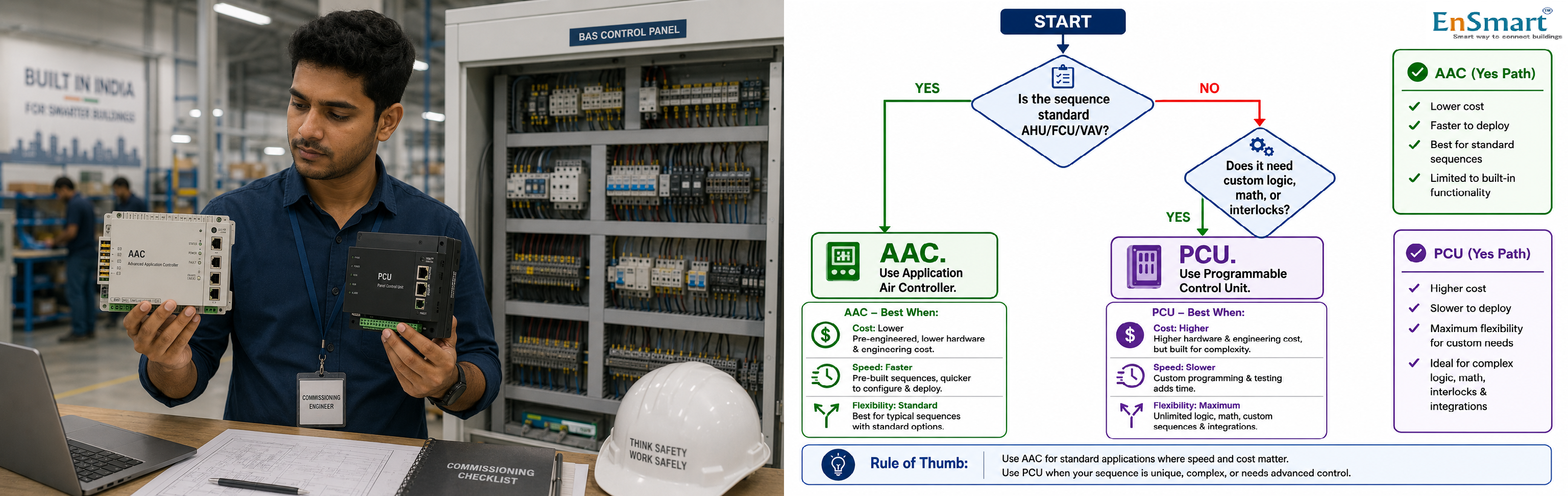
A Coimbatore Panel Floor, Two Boxes on the Bench
Selva is a junior commissioning engineer at a panel-build floor in Coimbatore. His supervisor brings two cartons to the bench. "This project — six AHUs and one chiller plant. AAC for the AHUs, PCU for the chiller plant. Programme them by Friday." Selva opens the cartons. The AAC carton has six identical small boxes. The PCU carton has one larger box. He has heard the terms in college but never used them. He asks his supervisor for the difference. The supervisor smiles. "AAC — application-specific controller. Already knows how to run an AHU. You only set the parameters. PCU — programmable controller. Knows nothing. You teach it the sequence with FBD blocks. Use AAC where the equipment is standard. Use PCU where the equipment is unique." Selva writes this down. Every single one of these problems has one solution — knowing which controller belongs to which equipment.Application-Specific Controllers (AAC)
An AAC is a controller that ships pre-programmed for a specific equipment family — most commonly AHU, FCU, VAV, RTU, heat pump, or chiller starter. The logic is built in. The IO points are mapped. The factory has tested the sequences. ``` What an AHU AAC ships with: - Hard-coded inputs: return temp, supply temp, mixed temp, return RH, return CO2, supply pressure, DPT across filter - Hard-coded outputs: cooling valve modulation, heating valve, fresh-air damper, return damper, fan VFD - Hard-coded logic: PID on supply temp, demand-controlled ventilation on CO2, freeze protection, smoke mode tie-in - Configurable parameters: setpoints, deadbands, PID gains, schedules, alarm thresholds, occupancy mode behaviour ``` The commissioning engineer does not write the logic. The engineer connects the wires and sets the parameters. A complete AHU is up and running in under an hour.Programmable Controllers (PCU)
A PCU is a blank canvas. The IO mix is generic — say 16 universal inputs, 8 universal outputs, RS-485, BACnet IP. The logic is whatever the engineer draws in FBD (Function Block Diagram). PID, math, logic gates, schedules, latches, comparators — all assembled into custom sequences. ``` What a chiller plant PCU is asked to do: - Stage four chillers based on load - Sequence five primary pumps and four secondary pumps - Manage three cooling tower fans with VFDs - Coordinate with two DG sets and two grid feeds - Handle any one chiller's trip without losing supply - Reset CHW supply temp by load - Shed non-critical load during DG mode None of this is standard. Every chiller plant is different. A PCU is the right tool because it is configurable end-to-end. ``` A PCU programming task takes 1-3 days for a chiller plant, depending on complexity. The result is unique to that plant.The Decision Rule
``` Use an AAC when: - The equipment is standard (AHU, FCU, VAV, FCU-DX, RTU) - The IO mix matches the AAC's hard-coded points - The sequence is industry-standard - You want fast, repeatable commissioning - You want minimum FBD work Use a PCU when: - The equipment is non-standard (chiller plant, pump house, boiler plant, custom HVAC, custom utility) - The IO mix needs flexibility - The sequence is unique to this site - The interlocks span multiple equipment items - You want full control of the logic ```Why the Mistake Is Costly
Mixing them up shows up on day-3 of commissioning: ``` AAC put on a non-standard chiller Cannot stage 4 chillers, cannot manage secondary pumps, cannot coordinate DG. Site stuck at single-chiller mode. PCU put on a standard AHU Works, but FBD programming added 2 hours per AHU (12 hours for 6 AHUs). Cost recovery is hard. AAC under-spec on IO Some sensors connect, others don't. Engineer adds an extension box. Wiring becomes a guess. PCU over-spec on IO Customer paid for unused channels. Margin lost. CFO asks why. ``` A commissioning engineer who knows the difference selects the right controller before the cable is pulled — and saves the project two days, every time. The right controller for the equipment, not the other way around. AAC for standard. PCU for unique. Selva's bench rule applies on every project, every time.Related Topics
- What is BMS integration? — how a BMS connects with VFDs, energy meters, BACnet/Modbus devices and other building systems
- How to design a BMS system step by step — the complete BMS design methodology covering site survey, IO list, controller selection, sequence of operations
- What is a Building Management System (BMS)? — fundamentals of BMS controls and architecture for HVAC, lighting, energy and access
- What is BMS commissioning? — the disciplined commissioning process that turns a BMS install into a working building brain
- Browse all DDC Controllers topics — more from this section of the EnSmart BMS Library
Related Topics
- What is BMS integration? — how a BMS connects with VFDs, energy meters, BACnet/Modbus devices and other building systems
- How to design a BMS system step by step — the complete BMS design methodology covering site survey, IO list, controller selection, sequence of operations
- What is a Building Management System (BMS)? — fundamentals of BMS controls and architecture for HVAC, lighting, energy and access
- What is BMS commissioning? — the disciplined commissioning process that turns a BMS install into a working building brain
- Browse all DDC Controllers topics — more from this section of the EnSmart BMS Library
Related Topics
- What is BMS integration? — how a BMS connects with VFDs, energy meters, BACnet/Modbus devices and other building systems
- How to design a BMS system step by step — the complete BMS design methodology covering site survey, IO list, controller selection, sequence of operations
- What is a Building Management System (BMS)? — fundamentals of BMS controls and architecture for HVAC, lighting, energy and access
- What is BMS commissioning? — the disciplined commissioning process that turns a BMS install into a working building brain
- Browse all DDC Controllers topics — more from this section of the EnSmart BMS Library
Related Topics
- What is BMS integration? — how a BMS connects with VFDs, energy meters, BACnet/Modbus devices and other building systems
- How to design a BMS system step by step — the complete BMS design methodology covering site survey, IO list, controller selection, sequence of operations
- What is a Building Management System (BMS)? — fundamentals of BMS controls and architecture for HVAC, lighting, energy and access
- What is BMS commissioning? — the disciplined commissioning process that turns a BMS install into a working building brain
- Browse all DDC Controllers topics — more from this section of the EnSmart BMS Library
Was this answer helpful?
✓ Thanks — your feedback was recorded.