BACnet Gateway — When and Why a Building Needs One
Copied to clipboard ✓
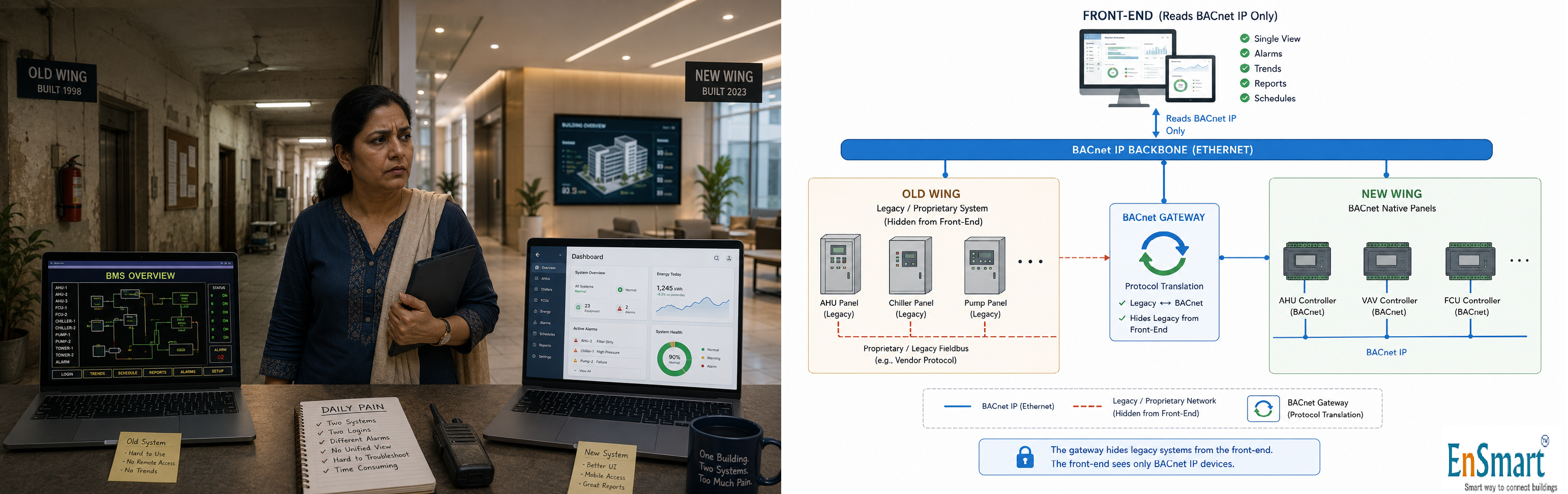
A Pune Mixed-Vendor Building, Two Languages, One Frustration
Manju is the new facility manager at a fifteen-year-old commercial complex in Pune. The site has been extended twice. Each extension came with a different BMS vendor. Each vendor brought its own front-end. Each front-end has its own password. ``` Original wing (2010) Vendor A, proprietary protocol First extension (2015) Vendor B, partial BACnet New wing (2023) BACnet IP, modern open ``` Three front-ends. Three operator stations. Three sets of trends. Three sets of alarms. When a tenant in the first extension reports a hot floor, Manju has to remember which login goes with which floor. ``` Monday morning at 9:14 AM: Tenant in Extension Block A: "AC not cooling on Floor 3" Manju logs into Vendor B front-end → Floor 3 AHU, supply temp 24 °C, setpoint 22 °C Cooling valve at 80 percent — should be more But the chiller plant is on the New Wing's BACnet front-end Different login, different graphics, different terminology By the time Manju traces the link, twelve minutes have passed ``` Three buildings inside one building. Every single one of these problems has one solution — a BACnet gateway that translates legacy protocols into BACnet IP.What a BACnet Gateway Does Differently
A Modbus-to-BACnet gateway translates Modbus into BACnet (which we covered separately). A BACnet gateway translates other proprietary protocols — including legacy BACnet variants and brand-specific protocols — into a clean BACnet IP that any modern front-end can read. ``` On the legacy side: Old wing's panels speak a proprietary protocol over RS-485. Manju's predecessor had the protocol document; it is now lost. The vendor charges for re-issuing the document. On the BACnet side, after the gateway: The 73 legacy points appear as BACnet objects on a network number assigned to the old wing. The new wing's BACnet IP front-end discovers them. The single front-end shows the whole building. ``` The gateway is a one-time investment. After it is configured, the legacy panels can keep running for another five to ten years while the operator's experience is unified.When a Building Needs One
``` Use a BACnet gateway when: - The building has multiple wings with different BMS vendors - One wing is being retrofitted but the others must continue - You want a single front-end without ripping out working panels - The legacy panels are healthy but their front-end has aged - The IT team wants one network to monitor, not three Do not use a BACnet gateway when: - The legacy panels are end-of-life and need replacement anyway - The protocol is so obscure no gateway supports it - The customer has budget for a full retrofit and prefers it ```Phased Retrofit Pattern — Where Gateways Shine
For a building like Manju's, the right strategy is phased retrofit using a BACnet gateway as the bridge: ``` Phase 1 — Bridge the legacy Install BACnet gateways for the original wing and Extension A. Both wings now appear as BACnet networks. Single front-end (the new wing's) can see everything. Tenants in old wings now get the same dashboard quality as the new wing tenants. Year 1. Phase 2 — Replace the oldest first Old wing panels are 15 years old. Spare parts are scarce. Replace them floor by floor on weekend cutovers. Each new panel is BACnet native — no gateway needed for it. The gateway shrinks in scope as panels are replaced. Year 2-3. Phase 3 — Retire the gateway When the last legacy panel is replaced, the gateway is removed. The whole building is now BACnet IP, single front-end. Year 4 typical. ``` The gateway buys the building four years of unified operation while the retrofit happens at a healthy pace.Configuration Notes
A BACnet gateway is configured similarly to a Modbus gateway, but the source side is the legacy protocol's native objects: ``` Source map (legacy proprietary) Point 0x0024 → Cooling Setpoint AHU-3 Point 0x0025 → Return Temp AHU-3 Point 0x0026 → Supply Temp AHU-3 Point 0x0027 → Damper Position AHU-3 BACnet objects (after mapping) AV-301 "AHU-3 Cooling Setpoint" (writable) AV-302 "AHU-3 Return Temp" AV-303 "AHU-3 Supply Temp" AV-304 "AHU-3 Damper Position" (writable) ``` The naming convention should match the new wing's BACnet objects, so operators see one consistent dashboard.Cost Justification
``` Option A — Rip and replace Cost: heavy. Disruption: heavy. Tenant impact: severe. Timeline: 6-12 months. Option B — Status quo (three front-ends) Cost: ongoing operator overhead. Time lost per tenant complaint: 10-15 minutes. Mistakes when operators switch contexts. Option C — BACnet gateway + phased retrofit Cost: gateway hardware (one-time). Tenant impact: zero. Operator time recovered: 80 percent. Phased replacement at the right pace. ``` For most mixed-vendor buildings, Option C wins on every dimension. Three buildings inside one. A gateway makes them one. The legacy stays alive long enough to retire gracefully — not violently.Related Topics
- What is BMS integration? — how a BMS connects with VFDs, energy meters, BACnet/Modbus devices and other building systems
- How to design a BMS system step by step — the complete BMS design methodology covering site survey, IO list, controller selection, sequence of operations
- What is a Building Management System (BMS)? — fundamentals of BMS controls and architecture for HVAC, lighting, energy and access
- What is BMS commissioning? — the disciplined commissioning process that turns a BMS install into a working building brain
- Browse all Protocols topics — more from this section of the EnSmart BMS Library
Related Topics
- What is BMS integration? — how a BMS connects with VFDs, energy meters, BACnet/Modbus devices and other building systems
- How to design a BMS system step by step — the complete BMS design methodology covering site survey, IO list, controller selection, sequence of operations
- What is a Building Management System (BMS)? — fundamentals of BMS controls and architecture for HVAC, lighting, energy and access
- What is BMS commissioning? — the disciplined commissioning process that turns a BMS install into a working building brain
- Browse all Protocols topics — more from this section of the EnSmart BMS Library
Related Topics
- What is BMS integration? — how a BMS connects with VFDs, energy meters, BACnet/Modbus devices and other building systems
- How to design a BMS system step by step — the complete BMS design methodology covering site survey, IO list, controller selection, sequence of operations
- What is a Building Management System (BMS)? — fundamentals of BMS controls and architecture for HVAC, lighting, energy and access
- What is BMS commissioning? — the disciplined commissioning process that turns a BMS install into a working building brain
- Browse all Protocols topics — more from this section of the EnSmart BMS Library
Related Topics
- What is BMS integration? — how a BMS connects with VFDs, energy meters, BACnet/Modbus devices and other building systems
- How to design a BMS system step by step — the complete BMS design methodology covering site survey, IO list, controller selection, sequence of operations
- What is a Building Management System (BMS)? — fundamentals of BMS controls and architecture for HVAC, lighting, energy and access
- What is BMS commissioning? — the disciplined commissioning process that turns a BMS install into a working building brain
- Browse all Protocols topics — more from this section of the EnSmart BMS Library
Was this answer helpful?
✓ Thanks — your feedback was recorded.