What Does 'Native BACnet' Actually Mean? — The Question Every Consultant Should Ask
Copied to clipboard ✓
A Hyderabad Consultant's Desk, Four Datasheets, One Question
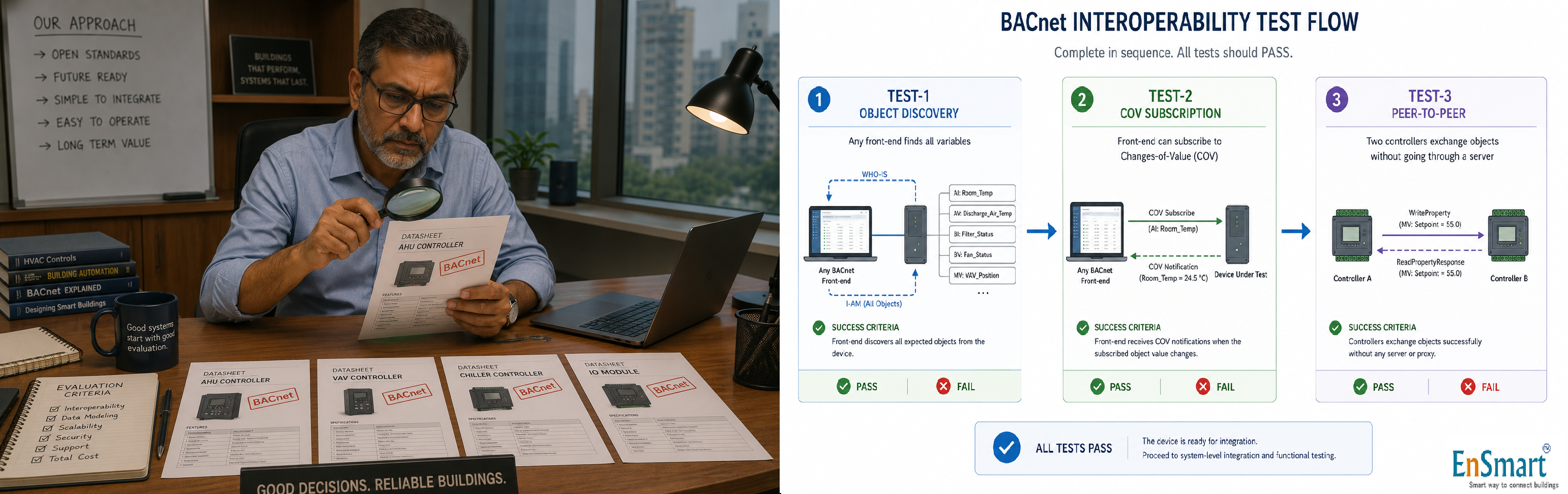
Arun is a senior MEP consultant in Hyderabad. He is finalising the BMS specification for a multi-tenant commercial tower. Four vendors have submitted technical compliance documents. All four claim BACnet compliance. All four show valid BTL listings. All four print the words "open protocol" on the cover page. Arun has been in this industry long enough to know that not all four are equally open. The datasheet word "BACnet" covers a wide range of architectures — and the consultant who signs the spec is the one who lives with the consequences. He sets the four datasheets aside and writes three field tests on a sheet of paper. Every single one of these problems has one solution — three field tests that no datasheet can fake.Why BTL Listing Is Not Enough
The BACnet Testing Laboratories (BTL) certifies products against the BACnet standard. A BTL Listed device has passed conformance tests for the BIBBs (BACnet Interoperability Building Blocks) it claims to support. ``` What BTL listing guarantees: - The device responds to BACnet messages it claims to support. - The PICS document accurately lists those BIBBs. What BTL listing does NOT guarantee: - That every variable inside the device is exposed as a BACnet object. Many proprietary backbones expose only a sample. - That a third-party front-end can perform full operations. Vendors can certify a small subset and still print "BACnet." - That COV subscriptions work on every meaningful object. - That two BACnet devices from different vendors can exchange objects peer-to-peer without a server. ``` A controller can be BTL Listed and still be effectively closed. The label is the floor of openness, not the ceiling.The Three Field Tests
These tests are run during the FAT (Factory Acceptance Test) before the controllers ship to site. The vendor cooperates because the tests are written into the specification. ``` Test 1 — Object Discovery ───────────────────────────────────────────────────────────── Procedure 1. Power up one controller from the vendor. 2. Connect a third-party BACnet client to the same network. 3. Request a Who-Is broadcast. 4. Capture the I-Am response. 5. Read the Object_List property of the device object. 6. Cross-check the object list against the manufacturer's point list document. Pass criterion Every variable that is read or written by the vendor's own front-end is also present in the BACnet object list visible to the third-party client. Fail signature The third-party client sees a partial list — for example, only AVs and BVs but not Multi-State Values or Schedules. Or sees fewer points than the manufacturer's documentation shows the device handling. Test 2 — COV Subscription ───────────────────────────────────────────────────────────── Procedure 1. From the third-party client, subscribe COV on AV-1 ("Return Air Temp") with a 0.5 °C threshold. 2. Apply a heat source to the temperature sensor at the controller end (or change the simulated input). 3. Observe the third-party client. Pass criterion The third-party client receives a COV notification within 10 seconds of the value crossing the threshold. Fail signature No notification arrives. Or notifications arrive only through the vendor's own front-end. Or the subscription request is rejected with an error. Test 3 — Peer-to-Peer Object Exchange ───────────────────────────────────────────────────────────── Procedure 1. Place two controllers on the same network — one from the vendor, one from a different BACnet-compliant vendor. 2. Configure the vendor's controller to read AV-100 from the other-brand controller via direct BACnet ReadProperty. 3. Configure the vendor's controller to act on the read value (for example, use it as a setpoint reference). 4. Change the value on the other-brand controller. 5. Observe the vendor's controller's behaviour. Pass criterion The vendor's controller reads the value directly, without routing through the vendor's own front-end or server, and acts on it. Fail signature The vendor's controller cannot read directly. Communication works only when both controllers are tunnelled through the vendor's proprietary front-end. ``` A vendor that passes all three tests offers truly native BACnet. A vendor that fails any one of them is paper-BACnet — open in name only.How to Write the Tests Into a Specification
Arun adds this clause to his BMS specification: ``` "All BMS field controllers and supervisor controllers shall support truly native BACnet. The vendor shall demonstrate the following three tests during the Factory Acceptance Test in the presence of the Owner and the Consultant: (a) Object Discovery using a third-party BACnet client. The controller shall expose every read/write variable as a discoverable BACnet object. (b) COV Subscription from a third-party BACnet client to a representative dynamic object, with notifications received within 10 seconds of value change. (c) Peer-to-Peer Object Exchange between the proposed controller and a different brand's BACnet controller, via direct ReadProperty / WriteProperty without any intermediate server. A signed witness report shall be issued on completion of each test. Failure of any test shall constitute non-compliance with the BACnet provisions of this specification." ``` This single clause — when enforced — separates open ecosystems from closed ones at the FAT, before any cable is pulled at site.Why This Matters in 2026
BMS investments last twenty years. The cost of a closed ecosystem is paid every year for those twenty years — in licence fees, in spare-parts lead times, in integrator availability, in front-end upgrade cycles. The cost of writing the three tests into the specification is two paragraphs. A consultant who writes the tests protects the building owner for two decades. A consultant who omits them transfers the cost to the building owner — usually invisibly, until the first vendor change is attempted. BTL listing is the floor. Native BACnet is the ceiling. Three field tests measure the gap. The specification that requires the tests is the cheapest insurance any building owner will ever buy.Related Topics
- What is BMS integration? — how a BMS connects with VFDs, energy meters, BACnet/Modbus devices and other building systems
- How to design a BMS system step by step — the complete BMS design methodology covering site survey, IO list, controller selection, sequence of operations
- What is a Building Management System (BMS)? — fundamentals of BMS controls and architecture for HVAC, lighting, energy and access
- What is BMS commissioning? — the disciplined commissioning process that turns a BMS install into a working building brain
- Browse all Protocols topics — more from this section of the EnSmart BMS Library
Related Topics
- What is BMS integration? — how a BMS connects with VFDs, energy meters, BACnet/Modbus devices and other building systems
- How to design a BMS system step by step — the complete BMS design methodology covering site survey, IO list, controller selection, sequence of operations
- What is a Building Management System (BMS)? — fundamentals of BMS controls and architecture for HVAC, lighting, energy and access
- What is BMS commissioning? — the disciplined commissioning process that turns a BMS install into a working building brain
- Browse all Protocols topics — more from this section of the EnSmart BMS Library
Related Topics
- What is BMS integration? — how a BMS connects with VFDs, energy meters, BACnet/Modbus devices and other building systems
- How to design a BMS system step by step — the complete BMS design methodology covering site survey, IO list, controller selection, sequence of operations
- What is a Building Management System (BMS)? — fundamentals of BMS controls and architecture for HVAC, lighting, energy and access
- What is BMS commissioning? — the disciplined commissioning process that turns a BMS install into a working building brain
- Browse all Protocols topics — more from this section of the EnSmart BMS Library
Related Topics
- What is BMS integration? — how a BMS connects with VFDs, energy meters, BACnet/Modbus devices and other building systems
- How to design a BMS system step by step — the complete BMS design methodology covering site survey, IO list, controller selection, sequence of operations
- What is a Building Management System (BMS)? — fundamentals of BMS controls and architecture for HVAC, lighting, energy and access
- What is BMS commissioning? — the disciplined commissioning process that turns a BMS install into a working building brain
- Browse all Protocols topics — more from this section of the EnSmart BMS Library
Was this answer helpful?
✓ Thanks — your feedback was recorded.