Modbus to BACnet Gateway — The Translator Between Two Worlds
Copied to clipboard ✓
A Bangalore IT Park, Three Protocols on One Site
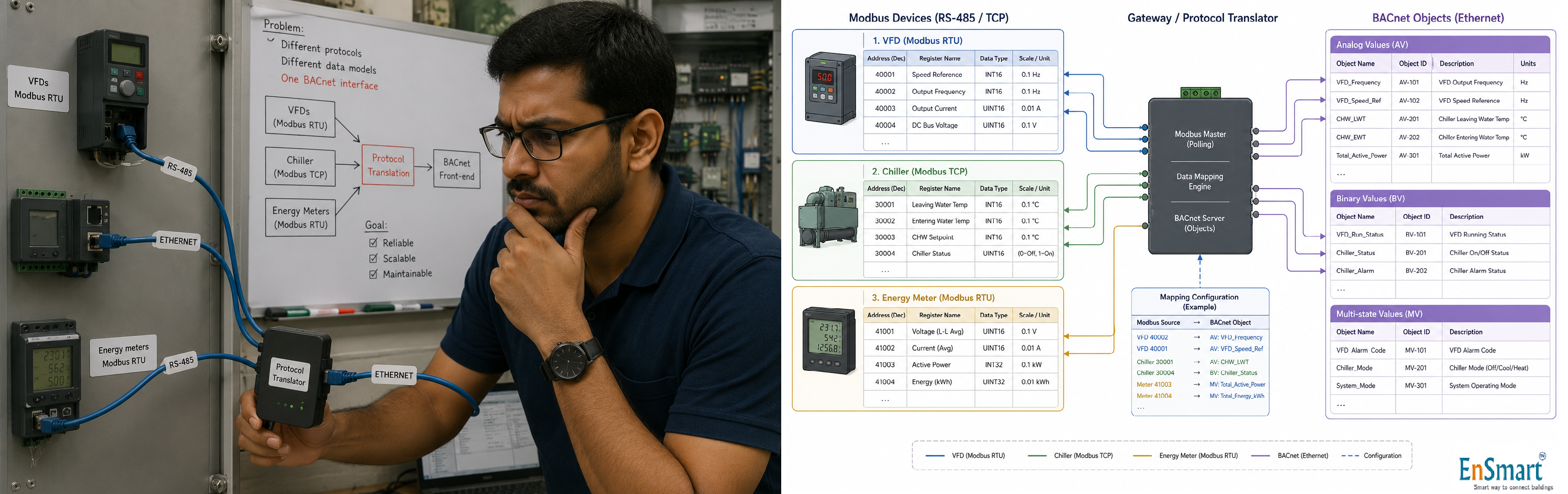
Ravi is the BMS integrator on a twelve-floor IT park in Bangalore. The customer wants a single front-end that shows everything. The front-end speaks BACnet IP. The site has: ``` 24 VFDs Modbus RTU on RS-485 daisy chain 2 chillers Modbus TCP on Ethernet 14 energy meters Modbus RTU on a separate RS-485 chain 8 UPS units Modbus RTU on a third RS-485 chain 6 transfer switches Modbus RTU on the UPS chain ``` The BACnet front-end discovers nothing from this site. The customer is paying for a "connected" building that is not connected. Ravi looks up the answer. Every single one of these problems has one solution — a Modbus to BACnet gateway.What a Gateway Does
A protocol gateway is a small device that speaks two languages — Modbus on one side, BACnet on the other. It maps each Modbus register to a BACnet object, so the BACnet front-end sees Modbus devices as if they were native BACnet devices. ``` On the Modbus side: Slave ID 12, baud 9600, register 40010 → VFD speed reference (read/write) Slave ID 12, baud 9600, register 40012 → VFD running status (read) Slave ID 12, baud 9600, register 40015 → VFD output current (read) Slave ID 12, baud 9600, register 40020 → VFD fault code (read) On the BACnet side, after mapping through the gateway: AV-1 "VFD-1 speed reference" (writable analog) BV-1 "VFD-1 running status" (binary value) AV-2 "VFD-1 output current" AV-3 "VFD-1 fault code" ``` The BACnet front-end discovers AV-1, AV-2, AV-3, BV-1 as native BACnet objects. The fact that they are Modbus on the other side is invisible.Gateway Sizing — Object Count Matters
Every gateway has a maximum object count. For a 12-floor IT park like Ravi's: ``` 24 VFDs × 8 useful registers each = 192 objects 2 chillers × 30 useful registers each = 60 objects 14 meters × 12 registers each (kWh, kW, V, A, PF, etc.) = 168 objects 8 UPS units × 6 registers each = 48 objects 6 transfer switches × 4 registers each = 24 objects ───── Total = 492 objects ``` Choose a gateway rated for ≥ 750 objects. Headroom matters — the next year's expansion always exceeds the original count.Configuration Walk-Through
The gateway is configured once via a web interface or a configuration tool: ``` Step 1 — Configure Modbus side RS-485 port 1: 9600 baud, 8N1, slaves 1-32 RS-485 port 2: 9600 baud, 8N1, slaves 1-16 Ethernet: Modbus TCP master at 192.168.10.50 Step 2 — Configure BACnet side Network number: 1001 Device instance: 100050 IP address: 192.168.10.250 COV support: enabled Step 3 — Map registers to objects Add device "VFD-1": slave-id 12, port 1 Holding 40010 → AV-1 "VFD-1 Speed", read/write, scale 0.01 Holding 40012 → BV-1 "VFD-1 Running", read, bit-extract bit 0 Holding 40015 → AV-2 "VFD-1 Current", read, scale 0.01 Holding 40020 → AV-3 "VFD-1 Fault", read, no scale Repeat for VFD-2 through VFD-24, scaling rules common. ``` A well-organised configuration takes 30-45 minutes for 24 VFDs because the mapping pattern repeats.Common Pitfalls
``` Wrong byte order Reading correct register, getting nonsense. Test by writing a known value and reading back. Slave ID conflict Two devices same ID on the same chain. Use a Modbus scanner to discover all responders. Baud rate mismatch Half the chain responds, half does not. Confirm baud at every device before deploy. Termination missing Long chains drop packets intermittently. 120-ohm resistor at both ends of RS-485. Polling too aggressive Gateway overwhelms the chain. Slow scan rate to 5-10 seconds for slow values. ```COV — The BACnet Advantage
Once mapped, the gateway can publish change-of-value (COV) updates to the front-end. The front-end no longer polls every second — it subscribes once and gets notifications when values change. For 492 objects, this is the difference between a saturated network and a calm one. ``` Without COV (polling) Front-end asks 492 questions per second. Network is busy. Front-end is busy. Update lag: 1-3 seconds typical. With COV Front-end subscribes once. Gateway pushes updates only when a value changes. Network is quiet. Front-end is responsive. Update lag: under 1 second. ``` Three protocols on one site. One gateway in the middle. The BACnet front-end now sees the building as one unified system. The translation work happens once, in the gateway — and the building reads as connected, because it is.Related Topics
- What is BMS integration? — how a BMS connects with VFDs, energy meters, BACnet/Modbus devices and other building systems
- How to design a BMS system step by step — the complete BMS design methodology covering site survey, IO list, controller selection, sequence of operations
- What is a Building Management System (BMS)? — fundamentals of BMS controls and architecture for HVAC, lighting, energy and access
- What is BMS commissioning? — the disciplined commissioning process that turns a BMS install into a working building brain
- Browse all Protocols topics — more from this section of the EnSmart BMS Library
Related Topics
- What is BMS integration? — how a BMS connects with VFDs, energy meters, BACnet/Modbus devices and other building systems
- How to design a BMS system step by step — the complete BMS design methodology covering site survey, IO list, controller selection, sequence of operations
- What is a Building Management System (BMS)? — fundamentals of BMS controls and architecture for HVAC, lighting, energy and access
- What is BMS commissioning? — the disciplined commissioning process that turns a BMS install into a working building brain
- Browse all Protocols topics — more from this section of the EnSmart BMS Library
Related Topics
- What is BMS integration? — how a BMS connects with VFDs, energy meters, BACnet/Modbus devices and other building systems
- How to design a BMS system step by step — the complete BMS design methodology covering site survey, IO list, controller selection, sequence of operations
- What is a Building Management System (BMS)? — fundamentals of BMS controls and architecture for HVAC, lighting, energy and access
- What is BMS commissioning? — the disciplined commissioning process that turns a BMS install into a working building brain
- Browse all Protocols topics — more from this section of the EnSmart BMS Library
Related Topics
- What is BMS integration? — how a BMS connects with VFDs, energy meters, BACnet/Modbus devices and other building systems
- How to design a BMS system step by step — the complete BMS design methodology covering site survey, IO list, controller selection, sequence of operations
- What is a Building Management System (BMS)? — fundamentals of BMS controls and architecture for HVAC, lighting, energy and access
- What is BMS commissioning? — the disciplined commissioning process that turns a BMS install into a working building brain
- Browse all Protocols topics — more from this section of the EnSmart BMS Library
Was this answer helpful?
✓ Thanks — your feedback was recorded.