BACnet IP vs BACnet MS/TP — IT Network vs Field Network
Copied to clipboard ✓
A Hyderabad Hospital, IT Says No
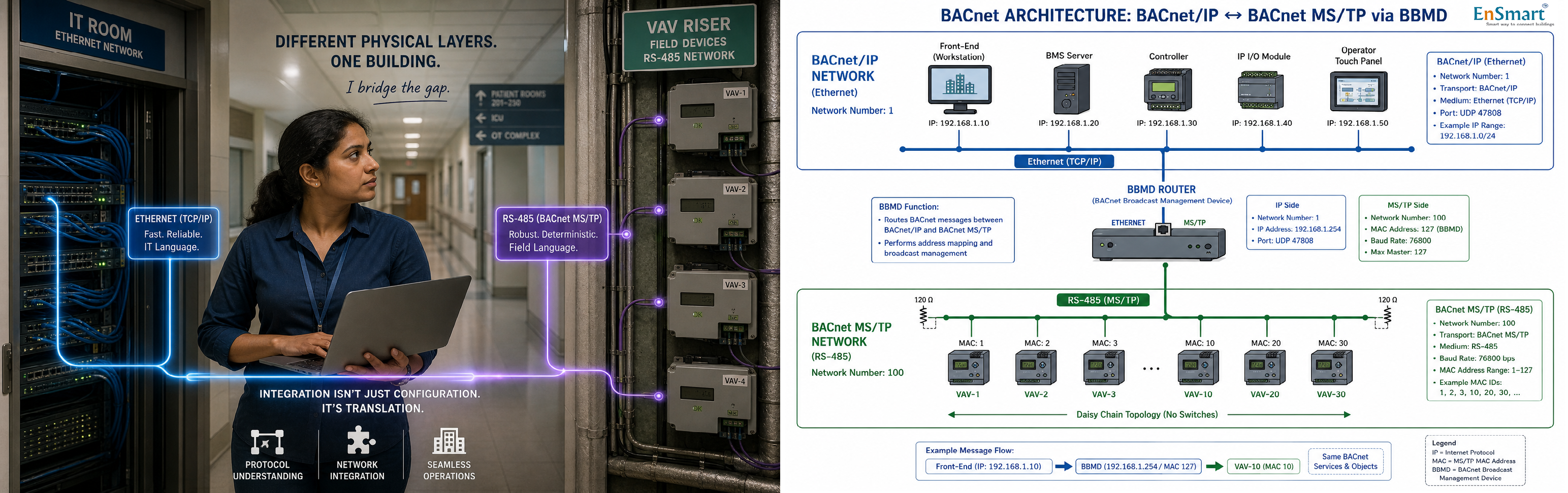
Bhavani is the BMS engineer on a hospital BMS retrofit in Hyderabad. The hospital is twelve years old. The chiller plant and AHUs were retrofitted last year with BACnet IP controllers. Last week's scope adds: replace 16 VAV controllers across the patient floors. The IT department reviews her plan and pushes back: "You have already taken 8 IP addresses for the chiller and AHUs. We cannot allocate 16 more IPs for VAVs. The corporate IP plan is full. You will have to find another way." Bhavani knows the answer. The 16 VAVs do not need IP addresses. They need BACnet MS/TP, which uses RS-485, not Ethernet — and they connect to the BACnet IP network through a BBMD (BACnet Broadcast Management Device). She writes a one-page architecture note for the IT lead. Every single one of these problems has one solution — BBMD bridges the two physical layers.Same BACnet, Two Physical Layers
BACnet is one protocol that runs on multiple physical layers. The two most common in buildings: ``` BACnet/IP ───────────────────────────────────────── Physical Ethernet (CAT5/6, RJ45) Addressing IP address per device + BACnet device instance Speed 10/100/1000 Mbps Topology Star or mesh, through standard switches Typical use Supervisor controllers, front-ends, large-IO field controllers (chiller plant, big AHUs) Cost per device Higher (Ethernet hardware) BACnet MS/TP (Master-Slave/Token-Passing) ───────────────────────────────────────── Physical RS-485 (twisted pair) Addressing MAC address per device (0-127) + BACnet device instance Speed 9600 to 76800 baud Topology Daisy chain (single bus) Typical use VAV boxes, FCU controllers, small-IO field devices, large counts of identical units Cost per device Lower (RS-485 hardware) ``` The two layers carry the same BACnet messages — same objects, same services, same BIBBs. They differ only in how the messages are physically transported.Why MS/TP Suits Bhavani's VAVs
``` 16 VAV boxes per floor × 4 floors = 64 VAVs total Each VAV needs ~6 IO points = 384 points If each VAV needed an IP = 64 IPs That is most of a /25 subnet for one BMS function Versus MS/TP: 4 daisy chains (one per floor) = 4 RS-485 segments Each chain has 16 VAVs at MAC 1-16 The 4 chains terminate at one BBMD = 1 IP for the BBMD Total IPs used by 64 VAVs = 1 (just the BBMD) ``` That is the difference between "IT plan is full" and "IT plan still has 63 spare IPs."What a BBMD Does
A BBMD is a BACnet device that sits at the boundary between BACnet/IP and BACnet MS/TP. It performs three jobs: ``` Job 1 — Routing Forwards BACnet messages from IP devices to MS/TP devices and vice versa, based on the destination network number. Job 2 — Broadcast forwarding When a BACnet/IP device sends a broadcast (e.g., Who-Is), the BBMD forwards it onto the MS/TP segments so MS/TP devices respond. Otherwise broadcasts would die at the Ethernet boundary. Job 3 — Network coordination Maintains the routing table for the BACnet network numbers on each segment. The front-end can address an MS/TP device using its (network number, MAC address) tuple. ``` A BBMD is typically a physical device — sometimes a dedicated router, sometimes a feature inside a supervisor controller.Network Number Planning
BACnet uses network numbers to distinguish segments. Each MS/TP segment has its own network number. Each IP segment has its own. The BBMD knows the routing table. ``` Bhavani's hospital plan: Network 1 BACnet/IP backbone (chiller plant + AHUs + front-end) Network 11 MS/TP segment, Floor 1 VAVs (MAC 1-16) Network 12 MS/TP segment, Floor 2 VAVs (MAC 1-16) Network 13 MS/TP segment, Floor 3 VAVs (MAC 1-16) Network 14 MS/TP segment, Floor 4 VAVs (MAC 1-16) The BBMD is on Network 1 (IP) and routes to Networks 11-14. ``` The front-end addresses VAV-3 on Floor 2 as(network=12, MAC=3). The BBMD handles the routing automatically.
Token Passing on MS/TP
MS/TP is a master-slave-with-token-ring scheme. Only the device holding the token can transmit. The token rotates among masters in MAC order. ``` The token cycle: Master at MAC 1 holds token transmits, then passes to MAC 2 Master at MAC 2 holds token transmits, then passes to MAC 3 ... Master at MAC 16 holds token passes back to MAC 1 ``` This makes MS/TP deterministic — you know the maximum time before any device can speak. But it also limits the speed; for 16 devices at 38400 baud with average traffic, the round-trip time is about 1 second. For a VAV controlling room temperature, this is more than fast enough.Configuration Walk-Through
``` On the IP backbone (Network 1) Front-end IP: 192.168.10.10 Chiller plant controller IP: 192.168.10.20 AHU-1 controller IP: 192.168.10.21 ... BBMD IP: 192.168.10.30 On the BBMD IP side Network 1, IP 192.168.10.30 MS/TP port 1 Network 11, baud 38400, MAC 0 (MAC 0 is BBMD) MS/TP port 2 Network 12, baud 38400, MAC 0 MS/TP port 3 Network 13, baud 38400, MAC 0 MS/TP port 4 Network 14, baud 38400, MAC 0 Routing Auto On each VAV (Floor 2 example) Network 12, MAC 1 to 16 Baud 38400, 8N1 Termination 120-ohm at both ends of chain ``` After this configuration, the front-end discovers all 64 VAVs through the BBMD. Each VAV looks like a native BACnet device — because it is.Diagnostics
``` Symptom Likely cause ───────────────────────────────────────────────────────────── VAVs on one floor missing MS/TP segment broken (cable or termination). Start with the cable nearest the BBMD. Random VAV drops Baud rate mismatch on one or two devices. Or biasing missing on long segment. Token holding too long A device is misbehaving and not passing the token. Use a sniffer to find the slow device. BBMD reachable but VAVs not BBMD routing not configured. Check network numbers match between BBMD config and front-end's routing table. ```How Bhavani Closes the IT Conversation
Bhavani shows the IT lead the diagram. The IT lead approves one IP address — for the BBMD. The 64 VAVs run on RS-485, invisible to the corporate IP plan. The hospital saves 63 IPs and gets a faster, cheaper, simpler retrofit. Same BACnet. Two physical layers. One BBMD bridges them. The IT department keeps its IP plan. The BMS keeps its IO point density. Everyone wins — quietly.Related Topics
- What is BMS integration? — how a BMS connects with VFDs, energy meters, BACnet/Modbus devices and other building systems
- How to design a BMS system step by step — the complete BMS design methodology covering site survey, IO list, controller selection, sequence of operations
- What is a Building Management System (BMS)? — fundamentals of BMS controls and architecture for HVAC, lighting, energy and access
- What is BMS commissioning? — the disciplined commissioning process that turns a BMS install into a working building brain
- Browse all Protocols topics — more from this section of the EnSmart BMS Library
Related Topics
- What is BMS integration? — how a BMS connects with VFDs, energy meters, BACnet/Modbus devices and other building systems
- How to design a BMS system step by step — the complete BMS design methodology covering site survey, IO list, controller selection, sequence of operations
- What is a Building Management System (BMS)? — fundamentals of BMS controls and architecture for HVAC, lighting, energy and access
- What is BMS commissioning? — the disciplined commissioning process that turns a BMS install into a working building brain
- Browse all Protocols topics — more from this section of the EnSmart BMS Library
Related Topics
- What is BMS integration? — how a BMS connects with VFDs, energy meters, BACnet/Modbus devices and other building systems
- How to design a BMS system step by step — the complete BMS design methodology covering site survey, IO list, controller selection, sequence of operations
- What is a Building Management System (BMS)? — fundamentals of BMS controls and architecture for HVAC, lighting, energy and access
- What is BMS commissioning? — the disciplined commissioning process that turns a BMS install into a working building brain
- Browse all Protocols topics — more from this section of the EnSmart BMS Library
Related Topics
- What is BMS integration? — how a BMS connects with VFDs, energy meters, BACnet/Modbus devices and other building systems
- How to design a BMS system step by step — the complete BMS design methodology covering site survey, IO list, controller selection, sequence of operations
- What is a Building Management System (BMS)? — fundamentals of BMS controls and architecture for HVAC, lighting, energy and access
- What is BMS commissioning? — the disciplined commissioning process that turns a BMS install into a working building brain
- Browse all Protocols topics — more from this section of the EnSmart BMS Library
Was this answer helpful?
✓ Thanks — your feedback was recorded.