OPC UA in BMS — When BACnet Is Not Enough
Copied to clipboard ✓
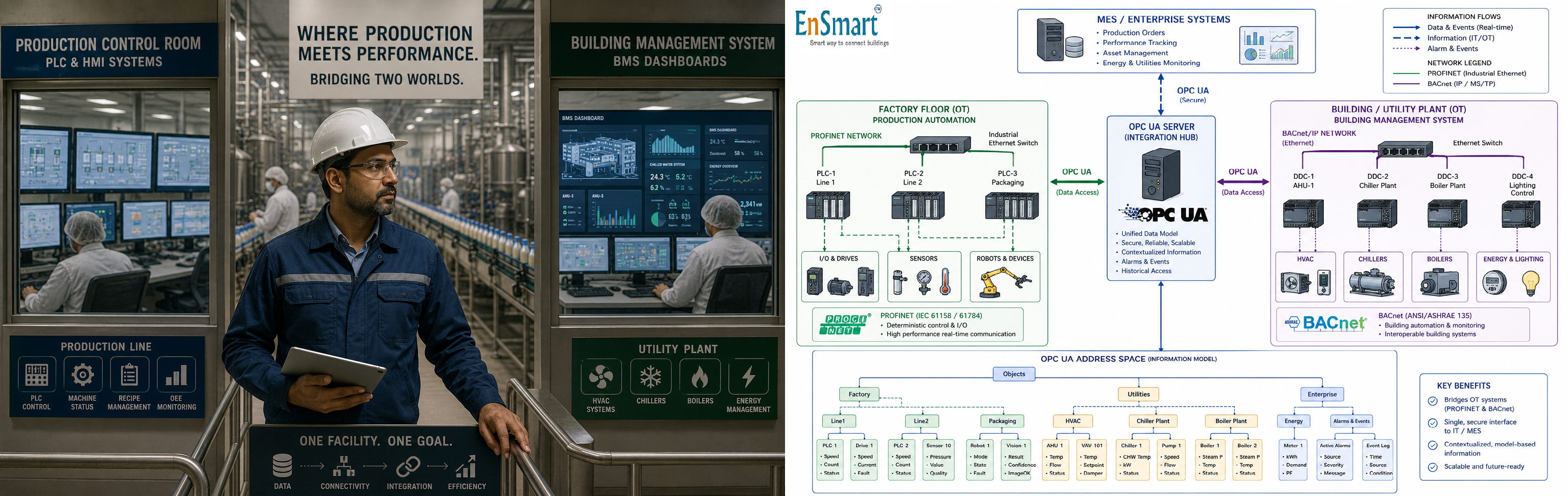
A Chennai Food Processing Plant, Two Worlds Under One Roof
Rajesh is the senior automation engineer at a food processing plant in Chennai. The site has two halves separated by a single wall: ``` Factory side (production line) Industrial PLCs running ladder logic PROFINET network for production cells EtherNet/IP for some packaging lines MES (Manufacturing Execution System) at the top Utility side (HVAC, water, electrical, compressed air) DDC controllers running FBD BACnet IP / MS-TP network for the utilities BMS front-end at the operator station ``` The CFO asks for one report every Monday: "How much energy did we use per kilogram of product last week?" Production data lives on the MES side. Energy data lives on the BMS side. They speak different languages. They have no common floor. Every single one of these problems has one solution — OPC UA, the common floor where buildings and factories meet.Why BACnet Cannot Reach Factory PLCs
BACnet is excellent for buildings. It models objects (Analog Value, Binary Value, Schedule, Calendar), supports services tuned to building automation (Read, Write, COV, Alarm, Schedule), and runs on physical layers common in buildings (IP, MS/TP). PLCs in factories speak protocols designed for production: PROFINET, EtherNet/IP, EtherCAT, Modbus. These prioritise deterministic timing, motion control, and tight cycle times — features BACnet does not provide. Conversely, factory protocols are weak at the things BACnet does well: modelling schedules, calendars, alarms with priority levels, multi-tenant access, and slow-changing analogue data with COV. The two worlds rarely overlap directly. BACnet does not reach the PLC. PROFINET does not reach the DDC.What OPC UA Provides
OPC UA (Open Platform Communications, Unified Architecture) is a vendor-neutral, platform-neutral protocol designed exactly for this gap. It became an IEC standard (IEC 62541) and is widely supported across industrial PLCs, MES, ERP, SCADA, and increasingly building controllers. ``` What OPC UA brings to the table: Address space Hierarchical, object-oriented namespace where every variable has a unique node ID. Variables can be discovered without prior knowledge. Information model Rich data types beyond simple read/write. Method calls, history access, alarms, events — all standard. Security TLS-based encryption, certificate-based authentication, user-level permissions. Built in, not bolted on. Transport TCP-based for reliability; can also run over MQTT or HTTPS for cloud scenarios. Discovery Local Discovery Server (LDS) lets clients find OPC UA servers on the network without static configuration. ``` For Rajesh's plant, OPC UA is the language both sides can speak — production PLCs already support it natively, and modern BMS controllers and gateways increasingly do too.Architecture Pattern — BMS to OPC UA to MES
``` Building utility side Factory production side DDC controllers (BACnet IP) PLCs (PROFINET / EtherNet/IP) | | v v BACnet to OPC UA gateway PLC's native OPC UA server | | +----------> OPC UA backbone <----------+ | v MES / ERP / Cloud analytics ``` A small server in the middle subscribes to nodes on both sides: ``` From the BMS side, the OPC UA server sees: - Compressor kWh per hour (from the air compressor BMS sub-meter) - Chiller plant kWh per hour - HVAC kWh per zone - Cleanroom DP excursions From the PLC side, the OPC UA server sees: - Bottles produced per minute - Packaging line uptime - Recipe being run - Batch number for the current production run ``` The MES on top reads from this OPC UA server and produces the CFO's Monday report: ``` Last week: Total product: 142,500 kg Total HVAC kWh: 38,200 Total compressed-air kWh: 12,800 Total chilled-water kWh: 24,400 Energy per kg of product: 0.53 kWh / kg Same week last year: 0.61 kWh / kg Improvement: 13 percent ``` That is a question neither BACnet alone nor PROFINET alone could answer. OPC UA in the middle makes it answerable.When You Need OPC UA — and When You Do Not
``` Use OPC UA when: - The site has both a building-automation network and an industrial-automation network that must share data. - MES, ERP, or cloud analytics needs structured access to both worlds. - Compliance or audit requires structured logs across both domains (food safety, pharma manufacturing, traceability). - Multi-vendor interoperability is required at the enterprise layer. You do not need OPC UA when: - The site is a pure commercial building (offices, malls, hospitals) — BACnet alone is the right answer. - There is no factory production system to integrate with. - The data sharing between BMS and IT systems is occasional and can be handled by simple file or database exports. ``` For Rajesh's food plant, OPC UA is essential. For a typical IT park, it is overkill.Configuration Notes
``` Step 1 — Inventory the data List the BMS variables the MES needs. List the PLC variables the BMS needs (often only a few — production status, recipe, batch number). Step 2 — Choose the gateway Many modern BMS gateways now include an OPC UA server. Many modern PLCs include one natively. In some cases, a dedicated OPC UA server appliance is needed to consolidate and secure both. Step 3 — Design the address space Use the manufacturer's standard companion specification if one exists for your equipment family. Otherwise design a hierarchical namespace that maps to the physical site. Step 4 — Set up security Generate certificates. Configure user-level permissions. Test that unauthorised clients cannot read or write. Step 5 — Test bidirectional flow Read a BMS value from the MES. Read a PLC value from the BMS. Confirm latency, freshness, and accuracy. ```Why This Matters in 2026
The boundary between buildings and factories is dissolving. Every modern manufacturing plant cares about energy per unit of production. Every modern food plant cares about HVAC stability during a recipe change. Every pharma plant ties cleanroom DP to manufacturing logs. OPC UA is the protocol that lets the two worlds talk without forcing one to adopt the other's habits. BACnet stays where it belongs — controlling the building. PROFINET stays where it belongs — running the production line. OPC UA carries the conversation between them. BACnet for buildings. PROFINET and EtherNet/IP for factories. OPC UA where the two meet. The Monday report finally writes itself — because the data finally has a common floor to walk on.Related Topics
- What is BMS integration? — how a BMS connects with VFDs, energy meters, BACnet/Modbus devices and other building systems
- How to design a BMS system step by step — the complete BMS design methodology covering site survey, IO list, controller selection, sequence of operations
- What is a Building Management System (BMS)? — fundamentals of BMS controls and architecture for HVAC, lighting, energy and access
- What is BMS commissioning? — the disciplined commissioning process that turns a BMS install into a working building brain
- Browse all Protocols topics — more from this section of the EnSmart BMS Library
Related Topics
- What is BMS integration? — how a BMS connects with VFDs, energy meters, BACnet/Modbus devices and other building systems
- How to design a BMS system step by step — the complete BMS design methodology covering site survey, IO list, controller selection, sequence of operations
- What is a Building Management System (BMS)? — fundamentals of BMS controls and architecture for HVAC, lighting, energy and access
- What is BMS commissioning? — the disciplined commissioning process that turns a BMS install into a working building brain
- Browse all Protocols topics — more from this section of the EnSmart BMS Library
Related Topics
- What is BMS integration? — how a BMS connects with VFDs, energy meters, BACnet/Modbus devices and other building systems
- How to design a BMS system step by step — the complete BMS design methodology covering site survey, IO list, controller selection, sequence of operations
- What is a Building Management System (BMS)? — fundamentals of BMS controls and architecture for HVAC, lighting, energy and access
- What is BMS commissioning? — the disciplined commissioning process that turns a BMS install into a working building brain
- Browse all Protocols topics — more from this section of the EnSmart BMS Library
Related Topics
- What is BMS integration? — how a BMS connects with VFDs, energy meters, BACnet/Modbus devices and other building systems
- How to design a BMS system step by step — the complete BMS design methodology covering site survey, IO list, controller selection, sequence of operations
- What is a Building Management System (BMS)? — fundamentals of BMS controls and architecture for HVAC, lighting, energy and access
- What is BMS commissioning? — the disciplined commissioning process that turns a BMS install into a working building brain
- Browse all Protocols topics — more from this section of the EnSmart BMS Library
Was this answer helpful?
✓ Thanks — your feedback was recorded.